
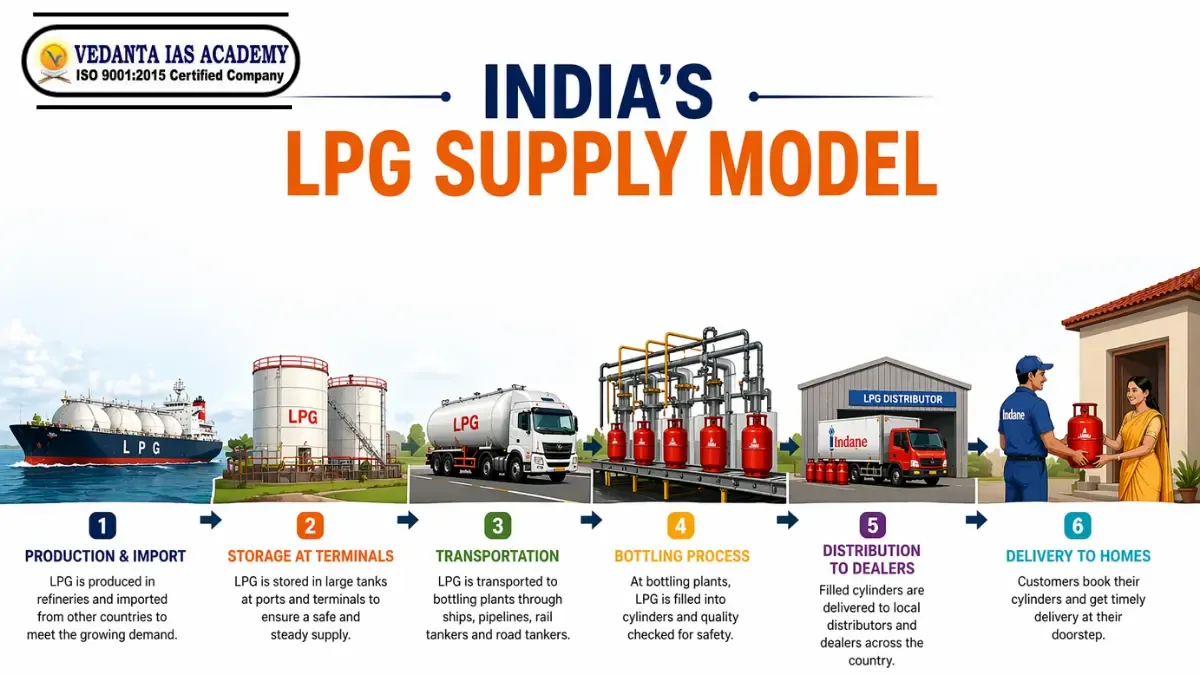

Today, almost every home in India uses LPG for cooking. But have you ever thought about how this gas reaches your kitchen? This whole system is called India's LPG supply model. It is a complete process that takes LPG from production to your home.
The Full Form Of LPG is Liquefied petroleum gas
In simple words, India's LPG supply model is a supply chain. It manages how LPG is produced, stored, transported, and delivered. The main goal is to make sure every household gets LPG safely and on time. This system connects refineries, storage units, distributors, and finally, consumers like you.
Let’s understand this in a simple and clear way. This is how LPG reaches your home in India.
1. Production and Import
Firstly LPG is made in oil refineries in India. However, this is not enough, so India also imports LPG from other countries using ships.
2. Storage at Terminals
After that, LPG is stored in large storage tanks at ports and terminals. This keeps the supply ready for further use.
3. Transportation
Then, LPG is transported to bottling plants. It is transported through pipeline, railway wagons or road tankers.
4. Bottling Process
At bottling plants, LPG is filled into cylinders. Each cylinder is checked carefully to ensure safety.
5. Distribution to Dealers
Filled cylinders are sent to local LPG distributors or dealers in different areas.
6. Delivery to Homes
Lastly, the delivery agents deliver cylinders to homes whenever customers order them.
This is a step process that demonstrates how a proper system ensures that LPG reaches all homes on time and safely.
Initially, LPG was not prevalent in India. It was used only in big cities by a small number of people. Firewood, coal or cow dung were used by most families especially in the villages. These were inexpensive fuels but were smoky and unhealthy. Gradually, the government began to increase the supply of LPG. The number of refineries constructed grew, and the number of gas connections in cities grew. Since the 1990s, things have improved more rapidly. Improved roads, transport, and policies assisted LPG to reach out to more areas.
The government initiated programs to support poor families, which was a big change. The Ujjwala Yojana gave free LPG connections to women in rural areas. This assisted in converting a number of households to clean cooking fuel.
Nowadays we can find LPG in nearly all Indian regions. The supply system is now more organized, faster and stronger. It is expanding with the increase in demand.
The government plays a very important role in this system.
It makes rules, controls prices, and provides subsidy support. It also ensures that LPG reaches every part of the country. Without government support, managing such a large supply system would be very difficult.
The government has launched many schemes to make LPG available, affordable, and easy to use for all people.
1. Pradhan Mantri Ujjwala Yojana (PMUY)
This is the most important LPG scheme. It gives free LPG connections to poor families, especially women in rural areas.
Before this, many families used wood or coal. After this scheme, they shifted to clean cooking gas. It improved health and reduced smoke in homes.
2. PAHAL (DBT) Scheme
PAHAL means Direct Benefit Transfer for LPG.
In this system, you pay the full price for the cylinder, and the subsidy money is sent directly to your bank account. This helps reduce corruption and ensures the right person gets the benefit.
India gets LPG from two main sources.
Domestic Production vs Imports
Some LPG is produced within India. But it is not enough to meet total demand. So, India imports a large amount of LPG from other countries.
Major LPG Exporting Countries to India
India mainly imports LPG from Middle East countries such as Saudi Arabia, Qatar, and UAE. These countries have large oil and gas reserves.
Dependency on Global Markets
Because of imports, India depends on global markets. If global prices increase, LPG prices in India also go up. This directly affects India's LPG supply model.
Oil Marketing Companies handle most of the supply work.
The main companies are Indian Oil, Bharat Petroleum, and Hindustan Petroleum.
They manage storage, bottling plants, and transportation. They also ensure cylinders reach local distributors and homes.
Urban Areas
Rural Areas
The government is working to improve this gap under India's LPG supply model.
Even though the system is strong, some challenges still exist.
These issues need proper planning and solutions.
The government provides subsidies to support low-income families.
Under the Direct Benefit Transfer system, consumers pay full price first. Then the subsidy is transferred to their bank account. This system reduces corruption and increases transparency.
Check our detailed article on DBT system in India to understand it better.
The supply system of LPG is not simply the cooking gas. It contributes significantly to the development and life of India.
1. Wide Household Coverage
There are over 31 crore LPG connections in India. This implies that the majority of the households have shifted to the use of LPG as compared to the traditional fuels. It demonstrates the power of the LPG supply system.
2. Clean Energy and Health Benefits.
Many families previously used wood and coal before LPG. This led to indoor air pollution.
Following the LPG growth, millions of households transitioned to clean fuel. Research indicates that clean cooking fuel can be used to mitigate health issues particularly among women and children.
3. Support to Rural Economy
In programs such as Ujjwala Yojana, the poor families received more than 9 crore free LPG connections.
This gave rise to more demand for cylinders, delivery services and local jobs in the rural areas.
4. Energy Security contribution.
India has a consumption of approximately 28-30 million tonnes of LPG annually. With a robust supply model, the country will have consistent energy and yet it will not run out even during peak times.
5. Economic Growth and Employment.
The LPG supply chain creates jobs in:
This sector has thousands of people directly and indirectly employed.
6. Boost to Digital Economy
LPG services are now digitalized with online booking, payment apps, and tracking systems. This can help India shift to a digital economy.
In recent years, many improvements have been made. Digital booking, online tracking, and faster delivery systems are now used. Infrastructure is also expanding. These changes are making India's LPG supply model more efficient and reliable.
Now we understand how India's LPG supply model works in a simple way. It is a well-organized system that connects production to households.
Over time, it has improved a lot, but some challenges still remain. With new reforms and better technology, the system is becoming stronger.
No comments yet. Be the first to comment!