
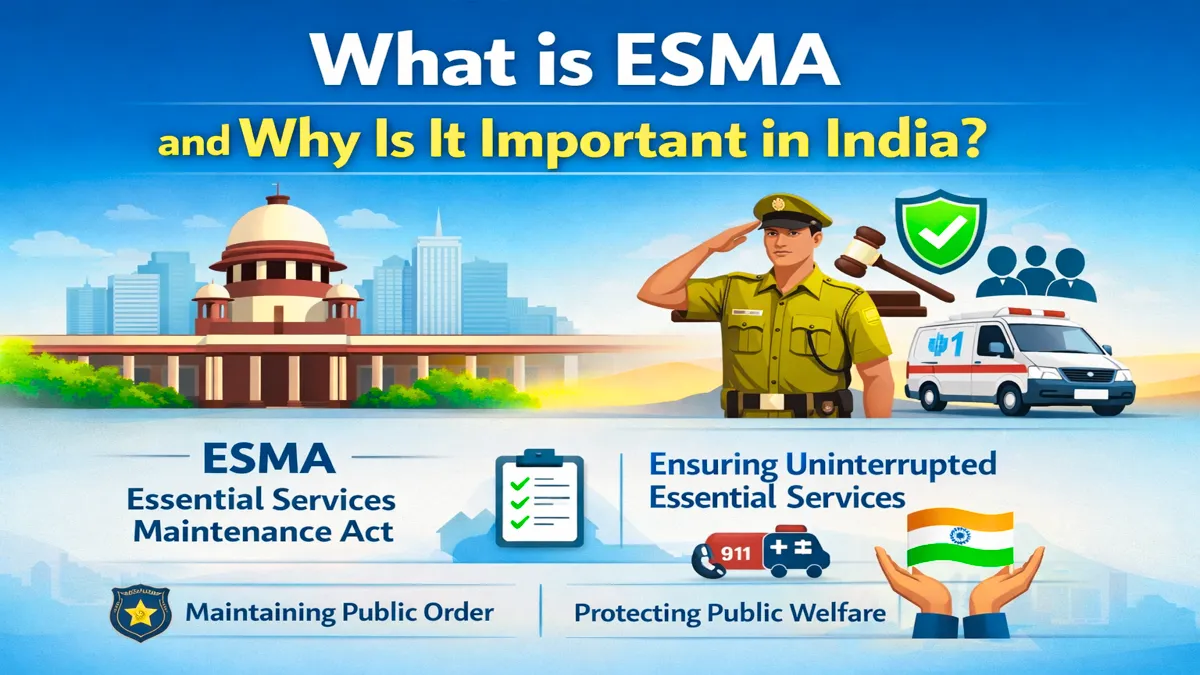

The Essential Services Maintenance Act (ESMA) whose name might sound technical to many people, but whose underlying principle is very simple as well as of crucial importance to the survival of millions of people in a country like India where provision of the essential services at all times is the main foundation of their daily existence.
Simply put, ESMA is a legal provision that allows the government to ban industrial action in the areas of essential services. Such a ban is justified as far as the end of such services may trigger an overall interference with everyday life. An example is the hypothetical shut down of the operations of hospitals, the stagnation of public transportation, or even a blackout of the country; these are the most disorderly scenarios that ESMA tries to prevent.
ESMA was unleashed in India in the year 1968 when the nation was experiencing severe strikes in the government sectors. These strikes were mostly accompanied by huge disruptions, particularly on transport and communication services. During the years, various states have adapted ESMA according to their situation because local problems should be addressed more efficiently.
Purpose Behind Its Implementation
The primary cause of ESMA was to create a balance between the rights of workers and the good of people. Although the right to protest and strike is relevant in a democracy, it becomes a problem when it is done in areas such as vital services which millions of people need in their daily lives.
Imagine it as follows: in case of the strike of a teacher, it influences learning. However when physicians strike, lives will be in danger. It is the line that ESMA attempts to follow.
The Essential Services Maintenance Act (ESMA) is an important piece of legislation aimed to make sure that critical public services do not come to a halt. To put it into perspective, its main provisions are outlined in the following sections with a clear but academic style.
ESMA gives significant powers to the government, including:
These powers might seem strict, but they are meant to ensure that the public does not suffer due to disruptions.
Essential services typically include sectors that are crucial for daily functioning. These may vary slightly from state to state but generally include:
Public Transport, Healthcare, and Utilities
Let’s break it down further. Suppose a big city and the buses have ceased to operate because of a strike. Office employees are unable to commute, students fail to attend classes, and companies lose. Now consider the situation when hospitals close this can give rise to life threatening situations.
This is why ESMA intervenes in such sectors in particular. It makes sure that these services continue to operate even when there is a dispute that the society does not fall under the pressure.
Maintaining Public Order
India is a densely populated country with a complex system of public services. Any disruption can quickly spiral into chaos. ESMA plays a critical role in maintaining law and order, especially during times of crisis or large-scale protests.
It acts as a preventive measure, ensuring that essential services continue to function even when there is unrest.
Preventing Disruption in Daily Life
We should be honest and admit that our everyday life is based on the services of the community. All things are interrelated, starting with turning on the tap in the morning all the way to going to work. ESMA makes sure such fundamental needs are not disrupted.
In the absence of such a law even a minimal strike would have a domino effect as whole cities would be derailed and it would have changed the lives of millions of people.
Implementation by Government
ESMA is not always active. It is normally imposed when there is an emergency situation or when a strike threatens necessities. The government notifies of the ESMA in a given area or sector. Workers in such services, once under the enforced ones, are under legal obligation to work.
Duration of Enforcement
ESMA is normally imposed over a short time which is usually to a maximum of six months. The government however can increase this period in case the situation requires it.
Any strike or interference during this time is deemed as illegal and ruthless measures are taken against the individuals involved.
ESMA is one of such laws which silently keeps the country running. You might not watch it on the daily round but the influence is enormous. It keeps millions of people inconvenienced and safe by making sure that the key services are not disrupted by a crisis.
Meanwhile, it raises critical issues regarding the rights of workers and the government. Similar to any other potent instrument, ESMA should be applied in a responsible manner.
Knowledge in ESMA is very essential, particularly among those planning to go through competitive exams or just wishing to be informed on how governance is conducted in India. Anyway, the daily operations of society are more influenced by laws such as these than we can actually imagine.
Q1. What is the main purpose of ESMA?
Ans. The main purpose of ESMA is to ensure that essential services like healthcare, transport, and electricity continue without disruption, even during strikes.
Q2. Who can impose ESMA in India?
Ans. Both the Central and State Governments have the authority to impose ESMA depending on the situation.
Q3. Is ESMA applicable all the time?
Ans. No, ESMA is applied only during emergencies or when essential services are at risk of disruption.
Q4. What happens if someone violates ESMA?
Ans. Violators can face penalties such as fines, imprisonment, or both, along with disciplinary action.
Q5. Why is ESMA controversial?
Ans. It is controversial because it restricts workers’ right to strike, leading to debates between protecting public interest and safeguarding labor rights.

What is the validity period of esma act in 2026 by government of odisha ?
Reply