20 Mar, 2026 12:54 PM

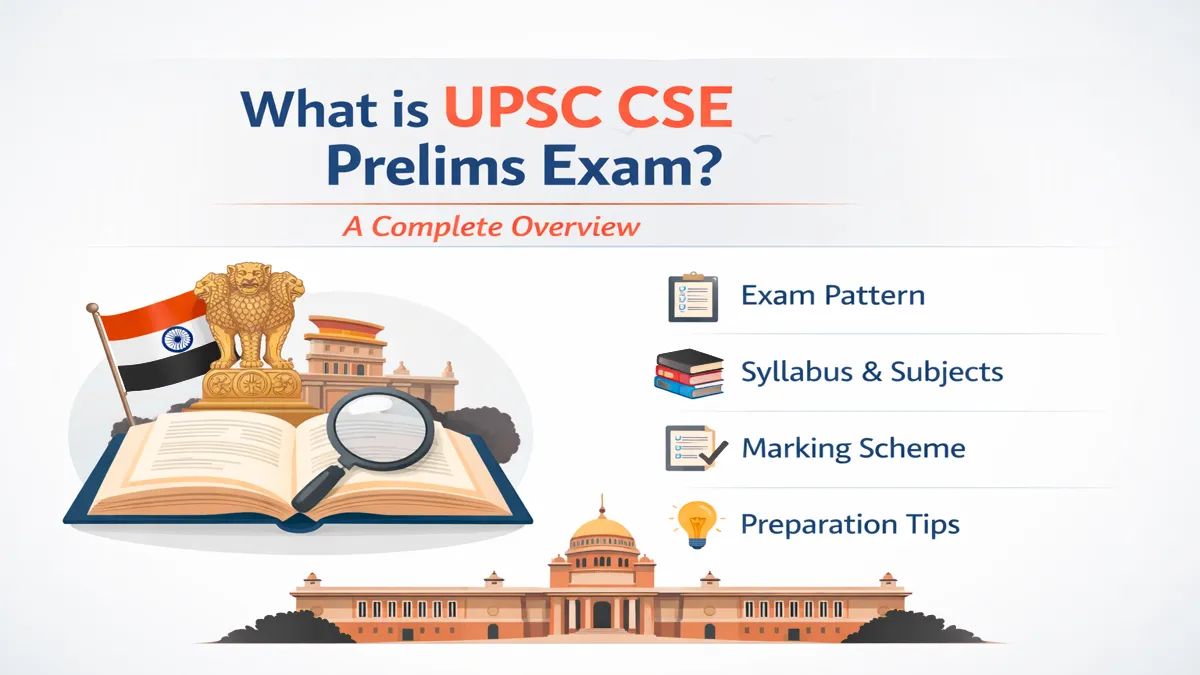
What is UPSC CSE Prelims Exam? A Complete Overview

Blog Highlights

  1. Introduction Section
  2. Understanding UPSC CSE Prelims
  3. Detailed Syllabus Section
  4. Study Plan Section
  5. Books & Resources
  6. Common Mistakes

UPSC Prelims is the first step of the Civil Services Exam in India. Which is conducted by UPSC (Union Public Service Commission). It has two papers GS Paper 1 and CSAT Paper 2. It is a screening test that selects candidates for the Mains Exam. Lakhs of students appear in it every year.

For beginners, understanding UPSC Prelims is the first step in IAS preparation.

Important points:

  • Only GS Paper 1 marks are counted for cut-off
  • CSAT requires only 33% marks to pass
  • Prelims marks are not included in final result

Why UPSC Prelims is the Most Crucial Stage in Civil Services Exam

because it acts as the first filter in the entire Civil Services journey. Out of lakhs of students who apply, only a few thousand clear this exam and move to Mains. If you fail here, your journey stops no matter how well prepared you are for Mains or Interview. It is the gateway that decides who gets a real chance at becoming an IAS, IPS, or IFS officer.

  • Around 10–12 lakh candidates apply
  • Only 10–15 thousand qualify for Mains

Key challenges:

  • Huge syllabus in UPSC Prelims
  • unpredictable questions
  • Negative marking in UPSC Prelims
  • Time pressure

So, having a strong UPSC Prelims strategy is very important.

UPSC Prelims Exam Pattern: Marks, Papers & Structure Explained

Understanding the IAS exam pattern is essential for beginners.

Features

GS Paper 1

CSAT (Paper 2)

Total Marks

200

200

Total Questions

100

80

Marks per Question

2

2.5

Negative Marking

(1/3rd of 2) - 0.66 

(1/3rd of 2.5) - 0.83

Duration

2 Hours

2 Hours

Paper Type

Objective (MCQ)

Objective (MCQ)

Qualifying Marks

Cut off - (90-110)

33% (66 marks)

Attempt Nature

Merit-determining (determines qualifying status for Mains)

Qualifying Only

Important:

  • GS Paper 1 decides your selection
  • CSAT is only qualifying but important

Exam structure:

  • Both papers are conducted on the same day
  • MCQ-based questions
  • OMR sheet marking

UPSC CSE Prelims Syllabus 2026: Subject-Wise Breakdown

Understanding the GS Paper 1 syllabus is key to success.

S. No.

Subject


1

History

  • Ancient, Medieval, Modern India
  • Freedom struggle 

2

Geography

  • Physical geography
  • Indian geography
  • Climate and agriculture   

3

Polity

  • Constitution
  • Fundamental Rights
  • Parliament and Judiciary

4

Economy

  • Basic concepts
  • Inflation, GDP, banking
  • Government schemes

5

Environment

  • Biodiversity
  • Climate change
  • National parks

6

Science & Technology

  • Basic science
  • Recent developments

7

Current Affairs

  • National & international news
  • Reports and indices


UPSC Paper 2, CSAT Strategy (Important for Beginners)

Even though CSAT is qualifying, do not ignore it.

Topics include:

  • Comprehension
  • Reasoning
  • Basic Maths
  • Data interpretation

Simple CSAT strategy:

  • Practice basic maths daily
  • Solve previous year questions
  • Focus on comprehension

How to Start UPSC Prelims Preparation from Zero

If you are a beginner and don’t know how to start IAS preparation, follow this:

Step 1: Understand the Exam

  • Learn syllabus and pattern
  • Know what to study and what to skip

Step 2: Start with NCERT Books

  • Class 6–10 for basics
  • Class 11–12 for advanced

Why NCERT?

  • Easy language
  • Builds strong foundation

Step 3: Read Standard Books

  • Polity
  • History
  • Geography
  • Environment

👉 Do not read too many books at once.

Step 4: Make Notes

  • Short and simple
  • Easy to revise

Step 5: Practice MCQs

  • Solve daily questions
  • Improve accuracy

Step 6: Follow a Study Plan

👉 Basic UPSC Prelims study plan:

  • 6–8 hours daily study
  • Divide time subject-wise
  • Weekly revision

Best Sources for Current Affairs for UPSC Civil Services Prelims

Current affairs play a major role in UPSC Prelims.

Best sources:

  • Daily newspaper (The Hindu / Indian Express)
  • Monthly current affairs magazines
  • Government websites

What to focus on:

  • Government schemes
  • Economy updates
  • International relations
  • Environment issues

Simple strategy:

  • Read news daily (30–45 minutes)
  • Make short notes
  • Revise monthly

Why Most Aspirants Fail in Prelims (And How to Avoid It)

Many students fail due to common mistakes.

Common mistakes:

  • Not understanding syllabus
  • Ignoring revision
  • Reading too many books
  • No mock test practice
  • Weak current affairs

How to avoid failure:

  • Stick to limited sources
  • Revise regularly
  • Practice MCQs daily
  • Focus on weak areas
  • Follow a clear strategy

Smart Tips:

  • Accuracy is more important than attempts
  • Avoid blind guessing
  • Focus on concepts, not memorization

Final Thoughts: Your Roadmap to Crack UPSC Prelims Successfully

Cracking UPSC Prelims is possible with the right strategy and consistency.

Your roadmap:

  1. Understand exam pattern
  2. Complete GS Paper 1 syllabus
  3. Practice CSAT regularly
  4. Focus on current affairs
  5. Solve mock tests
  6. Revise multiple times

Conclusion

UPSC Prelims is not just about hard work, it is about smart preparation. With the right UPSC Prelims preparation strategy, even a beginner can clear it in the first attempt.

Stay focused, follow a plan, and keep practicing.

Related blog - What is CSAT Exam?


0 Comments

No comments yet. Be the first to comment!

Reply to this Post