Geopolitical Bullying and the Breaking Barrier: US-Cuba Crisis and Russian Intervention
UPSC
Vedanta IAS Academy
04 May, 2026 04:08 PM

Geopolitical Bullying and the Breaking Barrier: US-Cuba Crisis and Russian Intervention
General Studies Paper – II: Governance, Constitution, Polity, Social Justice and International Relations
Context
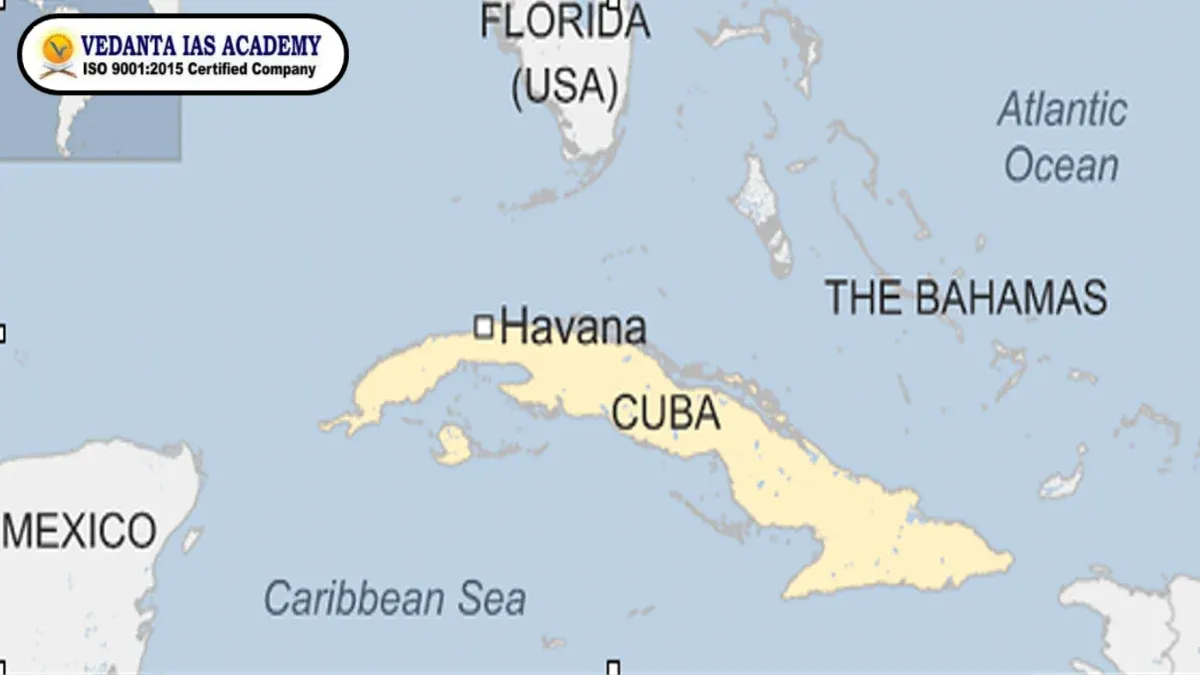
Relations between the US and Cuba have been strained since the Cold War era. The trade sanctions imposed by the US in the 1960s were aimed at destabilizing Cuba's communist government. Historically, under the 'Monroe Doctrine', the US has considered Latin America as its 'sphere of influence'. Currently, in President Donald Trump's second term, this policy has emerged as more aggressive, where economic sanctions are being used as a 'strategic weapon'.
Bully Blinks:
'Bully Blinks' refers to a situation where a powerful party (USA) failed to turn its threat into reality.
⦁ Incident: The US had enforced a naval blockade of Cuba to stop oil supplies from Venezuela.
⦁ Russian Challenge: Russia sent its oil tanker 'Anatoly Kolodkin' to Cuba as humanitarian aid.
⦁ Result: The US did not intercept this tanker. This is the exposure of the US "Bluff", as the US avoided direct military confrontation in the face of nuclear-armed Russia.
Why in Discussion?
This subject is the center of global discussion for the following reasons:
⦁ Fuel Crisis: A severe energy crisis has arisen in Cuba due to the cutting off of oil supplies from Venezuela.
⦁ Question of Sovereignty: Can the US stop a sovereign nation (such as Mexico or Russia) from trading with another country?
⦁ International Order: This step by Russia is a direct challenge to American unilateralism.
US Policy: National Interest or Trump's Personal Strategy?
This aggression in US foreign policy can be seen at two levels:
⦁ Trump's 'Donroe Doctrine': This is a narrow and aggressive version of the traditional 'Monroe Doctrine'. Under 'America First', it involves direct intervention (such as the abduction of the Venezuelan President or seizure of assets) by ignoring international rules.
⦁ Objective: To overthrow the decades-old communist government in Cuba and establish absolute dominance over Latin America. This policy is based more on Trump's personal philosophy of 'applying pressure' rather than US institutional policies.
Analysis of Iran, Venezuela and Tariff Strategy
⦁ Fuel and Sanctions: The US has imposed attacks and sanctions on oil-rich countries like Venezuela and Iran (under Israeli influence) to control the global energy market.
⦁ Economic War: Trump has made 'Tariffs' a diplomatic weapon. Part of this strategy is to paralyze the economies of countries that go against US interests by imposing heavy import duties on them.
Old Policies vs. Trump Era: Departure from International Organizations
Wide-ranging changes have occurred in US foreign policy after Trump came to power:
⦁ Abandonment of Multilateralism: The US has adopted a policy of withdrawing from or weakening international groups such as the Paris Climate Agreement, the Iran Nuclear Deal (JCPOA), and the World Health Organization (WHO).
⦁ Violation of Rule-based Order: The US now considers those international organizations a burden that limit its 'absolute freedom'.
Polarization and the Impact of 'America First'
The 'America First' policy has pushed global politics from 'de-polarization to re-polarization' (the return of polarization). Countries like Russia and China are filling the vacuum created by the US withdrawal from global leadership, which is again dividing the world into competitive camps.
⦁ 'America First' has presented the US as a 'selfish power' rather than a 'global policeman'.
⦁ Countries like Russia and China have got an opportunity to create a new 'pole' against US pressure.
Impact on India and Official Perspective
This situation presents complex challenges for India:
⦁ Strategic Autonomy: India has always supported historical ties with Cuba and the solidarity of the 'Global South'.
⦁ Energy Security: Sanctions on Iran and Venezuela affect India's energy supply and investment.
⦁ Official Position: India's clear view is that sanctions imposed on any country should be within the framework of the 'United Nations', and not unilateral. India favors the principles of 'Sovereign Equality' and 'Non-interference'.
Detailed Analysis of 'Bully Blinks':
⦁ Nuclear Deterrence: The arrival of the Russian ship in Cuba without any hindrance proves that the US can only put pressure on weak countries, not on nuclear powers.
⦁ Solidarity of a One-Party State: Despite Cuba's shortcomings (one-party rule), its 'Doctor Diplomacy' and anti-imperialist struggle have earned it international sympathy.
Analysis and the Way Forward
⦁ Balance of Power: Russia's successful intervention proves that unilateral bullying has limits. The international order runs not just by 'power' but by 'consensus'.
⦁ Need for Multipolarity: The current crisis inspires the global community to move towards a multipolar system where no single nation can control global trade routes and resources.
⦁ Diplomatic Solution: It is mandatory to adopt a humanitarian approach towards nations like Cuba and prioritize dialogue instead of sanctions.
Conclusion
Ultimately, the breaking of the blockade of Cuba is not just a tactical event, but a clear victory for 'multipolarity' against 'unilateral pressure' in global politics. This proves that military bullying and economic sanctions have their limits in the 21st century. It is imperative for nations like India to maintain their 'strategic autonomy' and support a just world order where respect for the sovereignty of any country is more paramount than a 'show of power'.