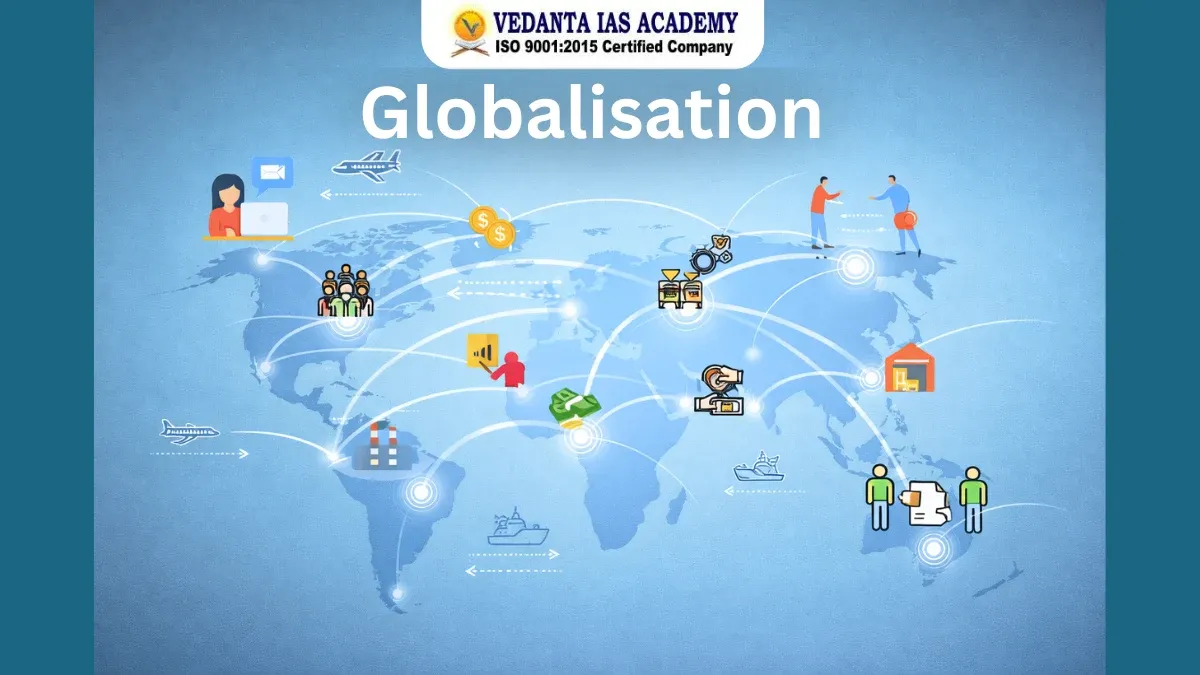

The globalisation meaning is simple. Today, the world is more connected than ever. Countries trade goods, share ideas, and use the same technology. This process is called globalisation.
For example, when India buys oil from another country or sells software services abroad, it is globalisation.
So, globalisation allows goods, services, money, and ideas to move freely across borders.
Academic Perspective
In academic language, the globalisation definition is the integration of economies and societies across the world.
It includes:
This definition is useful for writing answers in exams.
The features of globalisation help us understand how it works in real life.
1. Free Flow of Goods and Services
Countries buy and sell products easily. For example, India exports spices and imports electronics.
2. Movement of Capital
Money moves between countries. Foreign companies invest in India.
3. Growth of MNCs
Big companies work in many countries. These are called multinational companies.
4. Technology Growth
The Internet and smartphones make global connection fast and easy.
5. Cultural Exchange
People share food, fashion, and ideas across countries.
There are different types of globalisation:
Understanding these types helps you write better answers.
Before 1991, India had many restrictions.
India was not fully connected to the global market.
In 1991, India started major reforms called LPG.
This changed the path of globalisation in India.
After reforms, India saw rapid growth.
You can also read our guide on economic reforms in India to understand this better.
Globalisation has a strong effect on India’s economy.
India became a global player in sectors like IT.
So, globalisation has mixed results.
Globalisation also affects how people live.
Lifestyle Changes
People use modern products and follow global trends.
Cultural Exchange
We enjoy international food, movies, and fashion.
Effect on Traditions
Some traditional values are slowly changing.
Check our detailed article on the impact of western culture in India for more clarity.
Let’s look at the globalisation pros and cons.
The benefits of globalisation include:
These are the main advantages of globalisation.
There are also some problems:
So, we must balance both sides.
India faces some key challenges:
1. Unemployment
Some workers lose jobs due to machines and competition.
2. Regional Imbalance
Cities grow faster than villages.
3. Environmental Problems
Industries increase pollution.
4. Global Dependence
India depends on other countries for trade.
You can also read our guide on challenges of the Indian economy to learn more.
Now we understand the globalisation meaning, its features, and its effects.
Globalisation connects countries and helps growth. It brings many benefits of globalisation like jobs, technology, and trade. But it also has some downsides like inequality and cultural changes.
So, globalisation in India is both helpful and challenging. We should use its advantages wisely and reduce its negative effects. This topic is very important for exams. If you understand it clearly, you’ll be able to write strong answers.
No comments yet. Be the first to comment!