
General Studies Paper – III: Technology, Economic Development, Bio-diversity, Environment, Security and Disaster Management.
Context
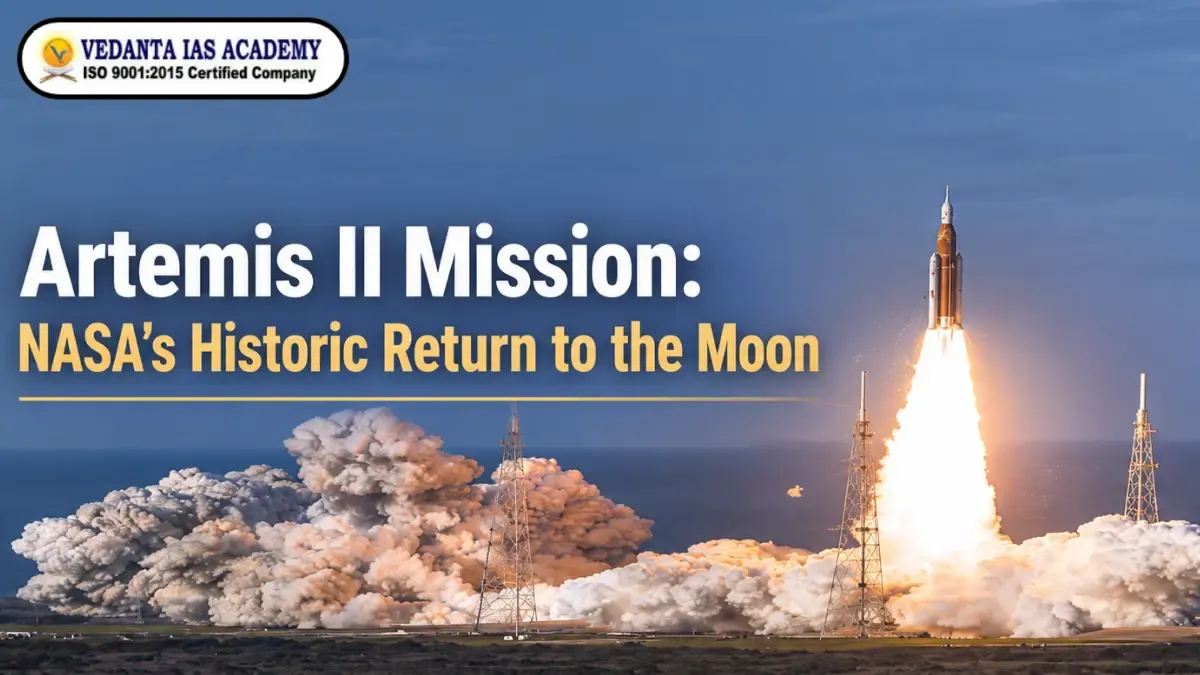
After a long gap of nearly 50 years, NASA is ready to take humans back to the vicinity of the Moon through its 'Artemis II' mission. Since 'Apollo 17' in 1972, this is the first such mission that will lead humanity into a new era of 'Deep Space' exploration. This mission is serving as a 'Proof of Concept' for future permanent lunar bases and Mars missions.
Launch Preparation: On Wednesday, NASA began the process of fueling its moon rocket at Launch Complex 39B at the Kennedy Space Center in Florida.
Fuel and Safety: More than 2.6 million liters of liquid hydrogen and oxygen are being loaded into the 32-story rocket. Strict monitoring of safety standards is being maintained in view of the 'hydrogen leak' issues encountered during previous tests.
Commander's Confirmation: Mission Commander Reid Wiseman confirmed this historic journey via 'X'. A lift-off was targeted for the evening with a forecast of favorable weather.
Nature of the Mission: This is a 'Crew-Flyby' mission. In this, the spacecraft will not land on the surface of the Moon nor will it enter its orbit; instead, it will loop around the Moon and return directly to Earth following a 'Free-return trajectory'.
Crew: It includes a total of four astronauts, three Americans and one Canadian.
New Global Record: These travelers will go about 6,400 km beyond the Moon, which will be a new global record for the farthest distance traveled from Earth by humans.
Return: After taking a 'U-turn' from behind the Moon, the craft will come straight toward Earth and perform a 'Splashdown' in the Pacific Ocean.
This is the world's most powerful operational rocket, with a height of approximately 322 feet.
Thrust: Its lift-off thrust is 8.8 million pounds, which is 15% more powerful than Apollo's Saturn V rocket.
Main Stage: It is equipped with four upgraded RS-25 engines, which use liquid hydrogen (LH2) and liquid oxygen (LOX). To keep it liquid, hydrogen is stored at an extremely cold temperature of -253°C.
Boosters (SRBs): Two giant Solid Rocket Boosters use PBAN (solid fuel), providing 75% of the thrust at lift-off.
Upper Stage (ICPS): It contains an RL10 engine, which pushes the 'Orion' capsule out of Earth's orbit toward the Moon.
Orion Capsule: This is the main part in which the passengers are seated.
European Service Module (ESM): This module ensures the supply of electricity, air, and water to Orion.
Working Mechanism: After the rocket separates, Orion corrects its direction using its own engines and returns to Earth using the Moon's gravity.
The Artemis II mission is not just a space journey, but a fundamental cornerstone toward future Mars missions and the establishment of permanent human settlements on the Moon. The return of astronauts to the Moon's periphery after 54 years defines new boundaries of science and human courage, opening new doors of space exploration for future generations.
Source - The Hindu
No comments yet. Be the first to comment!