Lodhi Samaj Scholarship Test Result Out 2026


General Studies Paper – III: Technology, Economic Development, Bio-diversity, Environment, Security and Disaster Management
Context
Article 25 of the Constitution grants every citizen the right to freedom of religion, but this right is subject to 'Public Order', 'Morality', and 'Health'. The Nalanda incident highlights that when the administrative machinery fails to maintain 'public order', personal faith transforms into a collective tragedy.
Located in Magadha village of Nalanda district, this temple is significant not only religiously but also historically:
⦁ Architectural Style: The temple is built entirely in the Nagara Style. Its prominent features include a high 'Jagati' (platform), an 'Antarala' (vestibule), and a grand 'Rekha-Prasad' Shikhara over the main 'Garbhagriha' (sanctum sanctorum).
⦁ Historical Context: The original form of the temple reflects the cultural influence of the Late Gupta Period of ancient Magadh. However, the main renovation of the current structure is believed to have taken place under the patronage of the Pala rulers, who patronized Hindu Shakti Peethas alongside Buddhism in this region.
⦁ Cultural Significance: The idol of Goddess Sheetla here is made of stone, who is considered the presiding deity of 'coolness' and 'wellness' (diseases like smallpox and fever) in Ayurveda and folk tradition. This reflects ancient 'folk-medicine' beliefs.
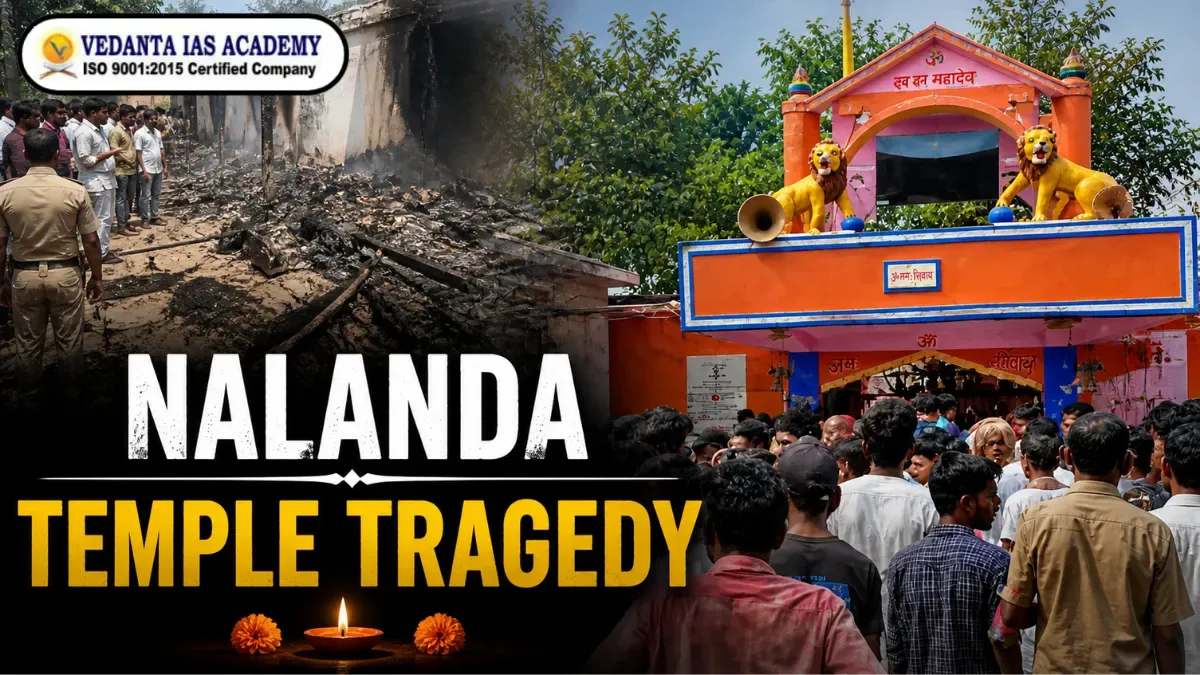
On March 31, 2026, a stampede occurred during worship at the Sheetla Mata Temple in Nalanda due to heavy crowds becoming uncontrollable.
⦁ Casualties: Death of 09 devotees (mainly women).
⦁ High-Level Response: Condolences expressed by President Droupadi Murmu and Prime Minister Narendra Modi.
⦁ Administrative Step: The Chief Secretary of Bihar has been directed to submit a preliminary investigation report within 24 hours.
⦁ Structural Failure: The ancient and narrow entrance of the temple is incapable of withstanding modern 'crowd density', creating a 'bottleneck' during emergencies.
⦁ Administrative Short-sightedness: Lack of 'Crowd Simulation' or mock drills despite having data on potential crowds on special days (Tuesday).
⦁ Inflow Beyond Capacity: Allowing thousands of people to enter without assessing the carrying capacity of the temple premises.
⦁ Administrative Oversight: Inadequate deployment of security personnel and lack of physical barriers like barricading for crowd control.
⦁ Lack of Information System: Failure of the public address system to provide directions to the crowd.
Government Initiatives and Legal Safety Framework
⦁ Financial Relief: Immediate assistance of ₹6 lakh by the Bihar Government and ₹2 lakh (for deceased) and ₹50,000 (for injured) by the Central Government.
⦁ Investigation and Accountability: Instructions to the Chief Secretary to identify factors of the incident and prepare a Standard Operating Procedure (SOP) for the future.
⦁ Constitutional Provision: It is the 'positive obligation' of the State to ensure the safety of citizens under Article 21 (Right to Life).
⦁ Legal Framework: Under the Disaster Management Act, 2005, it is mandatory for the District Magistrate (DM) to approve a 'Crowd Management Plan' for any large gathering, the violation of which is a punishable offense.
Religious events fall under the 'high risk' category for administration. A balance between personal 'faith' and the State's 'security guarantee' is essential here. According to NDMA guidelines, understanding 'crowd dynamics' in any religious event is the shared ethical responsibility of the organizers and the local administration.
The responsibility for safety at religious sites can be seen divided into two levels:
⦁ State Administration: Preparing the security perimeter and ensuring emergency exits.
⦁ Temple Trust/Committee: Regulation of the number of visitors and compliance with safety standards in internal architecture.
In the Nalanda incident, a 'lack of coordination' between these two levels is clearly reflected.
|
Date / Year |
Location |
Cause and Impact |
|
January 1, 2022 |
Vaishno Devi Temple, J&K |
Stampede triggered by heavy crowds on New Year and a minor scuffle between two groups. 12 people died. 'RFID' cards were made mandatory thereafter. |
|
August, 2022 |
Khatu Shyam Temple, Rajasthan |
Stampede occurred in Sikar district as soon as the temple doors opened in the morning; 3 women died. Excessive pressure on narrow paths was the main cause. |
|
2023 |
Banke Bihari Temple, Vrindavan |
Suffocation and stampede-like situation during Mangala Aarti due to heavy crowds; 2 devotees died. Demand for corridor construction intensified after this incident. |
|
July, 2024 |
Hathras Satsang, Uttar Pradesh |
A massive stampede occurred at the end of a religious gathering (Satsang) in the rush to touch the feet of the deity/guru. More than 121 people died. Considered the biggest tragedy in recent decades. |
Religious events fall under the 'high risk' category for administration. Here, a balance between personal 'faith' and the State's 'security guarantee' is essential. According to NDMA guidelines, understanding 'crowd dynamics' in any religious event is the shared ethical responsibility of the organizers and the local administration.
The Nalanda tragedy is not just a local accident but a serious warning for our disaster management system. The harmony between faith and modern safety protocols is the only way to prevent such 'man-made disasters' in the future. The governance must move beyond 'crowd control' and adopt a mindset of 'crowd management'. In any civilized society, the sacrifice of lives at the altar of faith is unacceptable. To prevent recurrence of such incidents, it is mandatory to fix administrative accountability with strict safety protocols and a 'zero tolerance' policy, so that religious tourism remains safe and accessible.
Source - The Hindu
No comments yet. Be the first to comment!