Slowdown in Index of Industrial Production (IIP): Technical Changes of New Series, Challenges and Way Forward
UPSC Current Affairs
Vedanta IAS Academy
02 Jun, 2026 12:49 PM

Slowdown in Index of Industrial Production (IIP): Technical Changes of New Series, Challenges and Way Forward
General Studies Paper – III: Technology, Economic Development, Biodiversity, Environment, Security and Disaster Management.
Current News Points
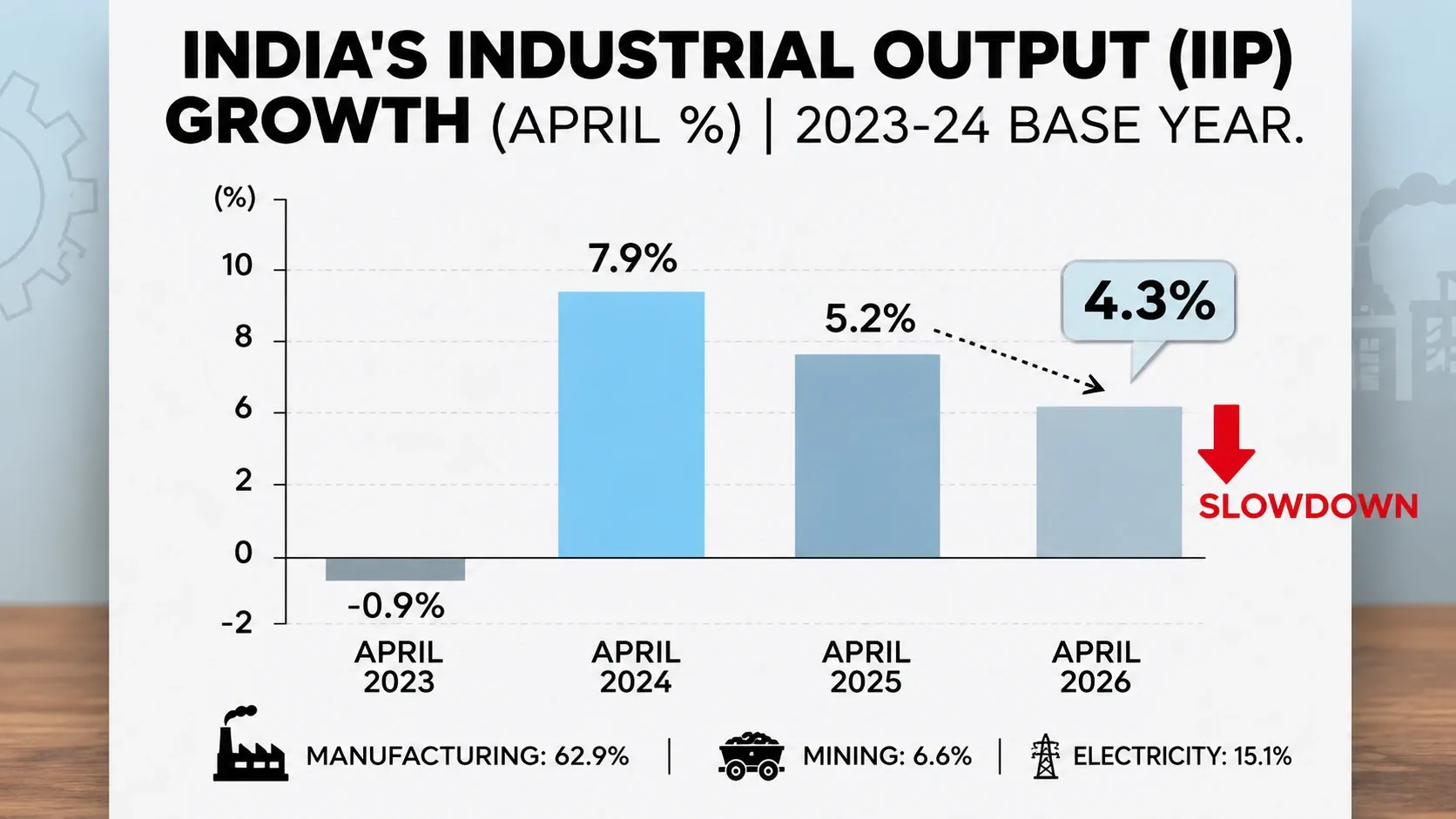
- Slowdown in Industrial Growth: India's industrial output (IIP) in April 2026 grew at a rate of 4.9% under the new series (base year 2022-23).
- Decline Compared to Previous Year: This growth rate has been slower than the 5.8% recorded in the previous year (April 2025) (under the old series).
- Expansion in the Scope of the Index: The scope of the new series has been widened by incorporating water supply, sewerage, waste management activities, and gas supply.
- Performance of Core Sectors: The old three core sectors (mining, manufacturing, and electricity) have been retained. In the reporting month, three out of four sectoral indices witnessed a slowdown, while one sector recorded a decline.
- Formula for Comparability: A special formula has been provided for users in the new series to ensure easy comparability between the old and new data series.
- Improvement in Granularity: The mining index will now have separate classifications for fuel, metallic (including rare earth minerals), and non-metallic minerals. Along with this, the electricity index has been divided into renewable and non-renewable sources.
- New Basket of Goods: For the calculation of IIP, 1,042 products mapped under 463 item groups have now been included, whereas the old series had only 839 products mapped under 407 item groups.
- Revision in Weights: The weights of various industries within the manufacturing sector have been revised in accordance with the latest Gross Value Added (GVA) 2022-23 series.
Statistical Data
- Total IIP Growth of April 2026: 4.9%
- Growth Rate of April Month in Previous Years: April 2023 (-0.1%), April 2024 (7.3%), April 2025 (5.8%)
- Mining and Quarrying Output: A decline (contraction) of over 5.1% was recorded in this.
- Manufacturing Sector Growth: Stood at 6.2% in the reporting month, which is slightly less than the 6.3% of the year 2025. (This sector constitutes about 75% of the total IIP basket).
- Contraction Within Manufacturing Sector: A total of 6 industries contracted, out of which the manufacture of "coke and refined petroleum products" shrank by 0.4% and the "wearing apparel" industry saw a decline of 7%.
- Industry with Maximum Decline: The manufacturing of wood products other than furniture witnessed the highest decline of 12.5%.
- Electrical Equipment Industry: A massive growth of 19.2% was recorded in this category within the manufacturing sector.
- Electricity and Gas Supply Sector: Grew at a rate of 4.9%.
- Water Supply, Sewerage and Waste Management: A growth of 6.6% was witnessed in this.
Data of Use-Based Classification:
- Primary Goods: 0.8% growth (slower than 2025).
- Consumer Durables: 4.3% growth (slower than 2025).
- Consumer Non-durables: 2.8% growth (slower than 2025).
- Intermediate Goods: Growth rate of 7.7% (0.19% faster compared to the same month of the previous fiscal year).
- Capital Goods: Growth rate quickened to reach 16%.
- Infrastructure/Construction Goods: Growth rate increased to 7.1%.
Reasons for Slowdown in Industrial Output
- Heavy Decline in Mining Sector: The contraction of over 5.1% in the mining and quarrying sector remained the primary reason for pulling down the overall industrial index.
- Weak Performance of Major Manufacturing Industries: The decline witnessed in 6 major industries of the manufacturing sector (such as petroleum products and textiles/wearing apparel) limited the overall manufacturing growth to 6.2%.
- Sluggishness in Consumer Demand: The slowing down of the growth rate of consumer durables and non-durables indicates that the final consumer demand in the market has not yet been fully strengthened.
- Impact of Statistical Revision: The inclusion of the new base year (2022-23) and the new basket of goods has changed the methodologies of comparative calculation, due to which this new trend is visible in the data.
Impact
- Effect on Economic Growth (GDP): IIP is considered a major indicator of economic growth; hence, a slowdown in it can increase pressure on the Gross Domestic Product (GDP) figures of upcoming quarters.
- Hurdle in Employment Generation: A decline in labor-intensive sectors like wearing apparel and manufacturing can adversely affect new employment opportunities in this sector.
- Market and Manufacturing Sentiment: The sharp increase in capital goods (16%) shows that investment is indeed taking place, but due to the slowdown in consumer goods, manufacturers may have to review their production strategy.
Analysis
The new series is more comprehensive and realistic as it incorporates green energy (renewable sources) and modern industries. However, the slowdown in consumer goods and primary goods indicates that rural and urban demand at the ground level still requires more encouragement; the 16% growth in capital goods is the only factor supporting the industrial system at this time.
Way Forward
- Incentivizing Domestic Demand: The government and policymakers will have to take measures that increase disposable income in both rural and urban areas to accelerate consumer demand.
- Support to Labor-Intensive Sectors: Sectors like textiles, apparel, and wood products should be given special financial packages or policy relaxations so that their contraction can be halted.
- Focus on Green and New Sectors: There is a need to further accelerate investment in clean energy projects by taking advantage of the new classification of renewable energy in the electricity index.
Conclusion
In short, the new IIP series based on the base year 2022-23 presents a more accurate and nuanced picture of the changing structure of the Indian economy. Although the slowing down of the industrial growth rate to 4.9% in April 2026 is a matter of immediate concern, the momentum witnessed in capital and infrastructural goods is a positive sign for the future. Through balanced policy interventions, industrial momentum can be regained by strengthening manufacturing and consumer demand.
Source - The Hindu