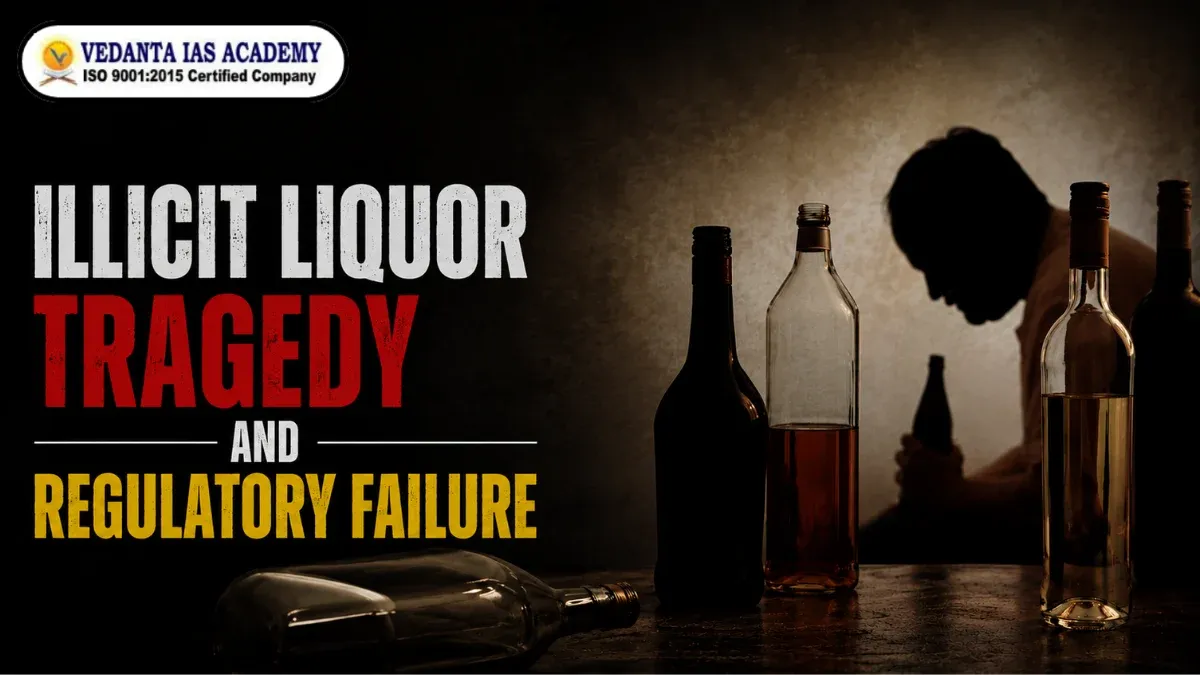
Illicit Liquor Tragedy and Regulatory Failure: A Deepening Public Health Crisis
UPSC Current Affairs
Vedanta IAS Academy
02 Jun, 2026 03:28 PM
Illicit Liquor Tragedy and Regulatory Failure: A Deepening Public Health Crisis
General Studies Paper – II: Governance, Constitution, Polity, Social Justice and International Relations.
What is a Perfect Storm?
According to the article, 'Perfect Storm' refers to the coming together of various adverse factors that repeatedly give rise to such tragedies:
- Combination of Regulatory Loopholes and Demand: On one hand, there is easy theft and availability of industrial methanol, and on the other hand, there is a continuous demand for extremely cheap liquor among economically weak and marginalized people.
- Adverse Impact of Policies: Steps such as high taxes on licensed liquor and total prohibition in some states ultimately complete this 'perfect storm', causing this deadly cycle to repeat time and again.
Why in News?
- Pune-Pimpri-Chinchwad Tragedy: Last week, more than 12 people from a working-class background died after drinking toxic liquor in the Pimpri-Chinchwad area of Pune.
- Disclosure of Organized Supply Chain: Preliminary investigation has revealed that this was not an instantaneous or local incident, but a well-organized supply chain was working behind it.
- Use of Industrial Grade Methanol: In this tragedy, industrial grade methanol was brought from outside the State and mixed with ethanol to produce a highly potent and toxic country liquor.
- Local Economy and Complicity: This business of illicit liquor was not completely secret but was operating as a 'semi-visible local economy', which depended on the tacit consent or tolerance of the local administration and police.
- Unfulfilled Promises of the Past: In the year 2015, a massive tragedy occurred in Malwani, Mumbai, in which more than 100 people lost their lives. At that time, grand official promises of systemic reforms were made, which have not fully materialized on the ground to date.
Main Reasons for these Incidents
- Re-routing and Theft of Methanol: The biggest shortcoming of the regulatory mechanism is that the 'downstream tracking' of methanol coming for industrial use is weak, making it easily pilfered and diverted to illicit liquor syndicates.
- High State Taxation: High taxes are levied by states on legitimate and licensed alcohol, making it expensive, and low-income poor consumers are forced to turn to illicit and cheap liquor.
- Massive Profit at Negligible Cost: Manufacturers of illicit liquor use toxic methanol to increase the volume of batches at a negligible cost, which dramatically increases their profit margins.
- Physical Exhaustion and Economic Uncertainty: Excessive fatigue and economic hardship of daily wage earners and manual laborers push them toward seeking cheap 'comfort or relief', ahead of which they even ignore the danger of poison.
- Weak Legal Action and Conviction Rate: Law enforcement agencies complete formalities by catching only small retail vendors. The investigation against the real kingpins of this trade always remains incomplete or inconclusive, due to which they do not get punished in courts.
Constitutional and Legal Provisions
- Article 47 (Directive Principles of State Policy - DPSP): It explicitly mentions that the State shall endeavor to raise the level of nutrition and the standard of living of its people and the improvement of public health. In particular, the State shall endeavor to bring about prohibition of the consumption except for medicinal purposes of intoxicating drinks and of drugs which are injurious to health.
- Seventh Schedule (List-II, State List): Production, manufacture, possession, transport, purchase, and sale of intoxicating liquors falls entirely under the State List (Entry No. 8), due to which states have the exclusive power to make laws and levy taxes on it.
Steps Taken by Government and Regulatory Initiatives
- Regulation of Industrial Alcohol: Rules have been formulated by central and state governments from time to time to prevent the misuse of methanol and other industrial alcohols, such as the Denatured Spirit Rules.
- Enforcement Actions: Following any major tragedy, Special Investigation Teams (SIT) are constituted by state governments, and raids are conducted on retail shops and illegal distilleries.
State-wise Analysis
In the given article, a specific mention has been made of mass deaths due to illicit liquor in several states of India, the analysis of which is as follows:
|
S. No.
|
Name of State
|
Specific Position / Impact of Policy
|
|
1
|
Maharashtra
|
Malwani tragedy in the year 2015 (100+ deaths) and recently the Pune-Pimpri-Chinchwad incident. Here, poison is being spread locally by bringing methanol in an organized manner from outside the State.
|
|
2
|
Bihar and Gujarat
|
Total prohibition is in force in both these states. According to the article, due to total bans, the market completely shifts into the hands of criminal syndicates, where there is no quality control or government oversight.
|
|
3
|
Tamil Nadu, Punjab, Uttar Pradesh, Assam
|
These states have also suffered the brunt of large-scale mass deaths from time to time due to illicit liquor, which shows that this crisis is not limited to any single geographical region.
|
Important Points
- Massive Share of Illicit Market: A 2024 analysis by public health experts shows that approximately 40% of the total alcohol consumption in India comes from the illicit market. This shows the terrifying nature of a parallel and unregulated economy.
- Lack of Political Will: Since most of the victims of this tragedy come from the lowest strata of society and marginalized communities, the sustained political will required to break this deadly cycle often appears to be lacking.
Analysis
According to the logical perspective of subject-matter experts, this problem is not merely one of law and order, but a comprehensive socio-economic and public health failure. Earning revenue by imposing high taxes on alcohol on one hand, and enforcing total prohibition on the other, both policies are proving to be failures at the ground level because they ultimately push consumers toward unsafe and cheap illicit markets. Until the big fish are caught and severely punished, this cycle will not break.
Way Forward
- Strict Audit of Methanol: A 'blockchain' or digital tracking system should be implemented from the manufacturing of industrial methanol to its final use, so that its theft and re-routing can be reduced to zero.
- Cheap and Safe Legal Accessibility: The government should balance the tax structure in such a way that legitimate and safe options are not very expensive for the poorest sections of society.
- Rehabilitation and De-addiction Centers: Health facilities, healthy means of recreation, and comprehensive de-addiction campaigns should be run for workers engaged in manual labor, so that the strike can be made at the level of demand itself.
- Accountability and Strict Laws: Accountability of local police and excise officials must be fixed, and instead of just retail vendors, the entire criminal network should be dismantled to ensure a high conviction rate.
Conclusion
Illicit liquor is not just an administrative lapse, but it has become a serious public health crisis before the country. Learning lessons from tragedies like Pune and Malwani, governments will have to rise above populist bans or merely revenue-centric policies. Until regulatory loopholes are removed and reforms at the policy level are implemented with full political will, it will remain impossible to ensure the safety of the lives of the poor and those standing on the margins.
Source - The Hindu