
Recently, the decision of the Supreme Court of India allowing the medical termination of pregnancy of a minor at an advanced stage of 28 weeks has ignited a new debate across the nation. While this ruling has placed reproductive autonomy at the forefront, it has simultaneously brought complex legal, ethical, and social issues surrounding medical ethics, foetal viability, and adolescent sexual activity into the center of public discourse.
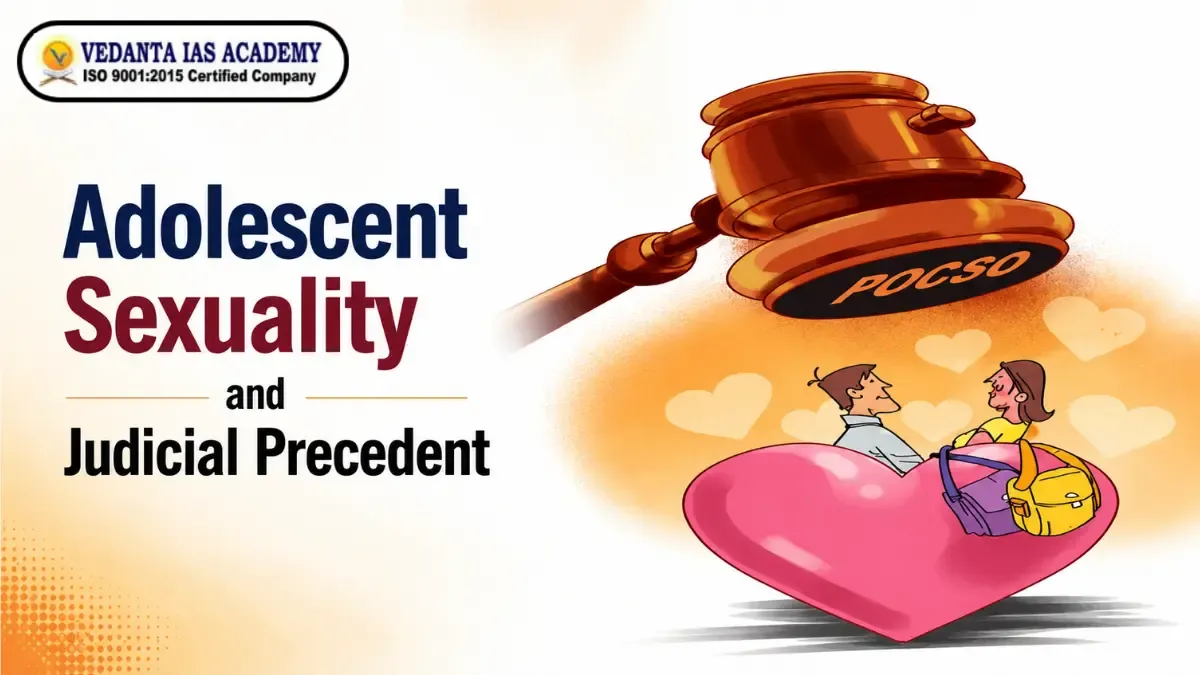

In the perspective of this article, 'Adolescent Sexuality' refers to the actual physical, biological, and emotional inclinations developing among adolescents. This is not merely a biological process, but a socio-psychological reality wherein de-facto consensual sexual relationships are established among adolescents - realities that are often completely ignored or suppressed by law and society.
⦁ Historic Decision of the Supreme Court: The Honorable Court granted special permission to an unmarried minor to terminate a 28-week pregnancy.
⦁ Petition by AIIMS Doctors: Doctors from the All India Institute of Medical Sciences (AIIMS) approached the court seeking a review of this decision.
⦁ Constraint of Time-Limit: Due to the expiration of the statutory limit under the Medical Termination of Pregnancy (MTP) Act, the extraordinary intervention of the Supreme Court became mandatory in this case.
⦁ Mental Trauma of the Minor: A critical situation came to light wherein the unmarried minor involved in this case had previously attempted suicide twice.
⦁ Delayed Detection of Pregnancy: The minor and her family discovered the pregnancy only when it had already reached an extremely advanced stage of approximately 28 weeks.
The following judgments are milestones in strengthening reproductive rights from a constitutional and judicial standpoint:
⦁ X v. Principal Secretary, Health and Family Welfare Department (2022): In this landmark judgment, the Supreme Court granted unmarried women the same rights as married women under the MTP Act. The Court clarified that "reproductive choice" is an integral part of personal liberty under Article 21 of the Constitution.
⦁ Suchita Srivastava v. Chandigarh Administration (2009): In this case, the Court held that a woman's reproductive autonomy falls within the ambit of her right to personal liberty, dignity, and privacy, which includes the right to carry or not to carry a pregnancy to term.
⦁ Mental and Physical Well-being: The Court accorded the highest priority to the extremely fragile mental health of the minor (suicidal attempts) and her future well-being.
⦁ Reproductive Autonomy: The Court observed that forcing any woman or minor to continue a pregnancy against her will is a violation of her fundamental rights.
⦁ Challenge of Judicial Precedent: Such decisions retain the potential to establish a new judicial precedent of bypassing the established boundaries of law for future cases.
⦁ Pressure on the Medical System: The moral and legal pressure on medical institutions to perform abortions in late-detection cases increases significantly.
⦁ Conflict of Rights: This decision creates a profound legal and philosophical contradiction between the rights of the woman and the right to life of the unborn child.
⦁ Warning of Medical Complications: AIIMS doctors argued that performing an abortion at 28 weeks practically means giving premature birth to a living child, who would face an exceptionally high risk of severe medical complications, long-term co-morbidities, and living with mental or physical disabilities.
⦁ Crisis of Dual Obligation: If the foetus is non-viable, the doctor's sole duty is toward the woman. However, in the case of a viable 28-week foetus, the doctor's moral duty automatically extends to the child to be born alive.
⦁ Paradox of the Oath: Executing a procedure that partially terminates or jeopardizes an unborn life creates deep mental and spiritual stress for doctors who have taken an oath to protect life (Hippocratic Oath). The court's order provides legal protection to the doctors but does not eliminate their inner moral dilemma.
⦁ As time progresses during gestation, the organs of the foetus inside the womb (especially the lungs and brain) continue to mature.
⦁ Edge of Viability: The period between 24 to 28 weeks is considered the 'edge of viability' in medical science. Beyond this stage, the foetus begins to acquire the capability to survive an independent life outside the womb with the help of modern neonatal care, making its rights more substantial.
Under the Medical Termination of Pregnancy (Amendment) Act, 2021, the following statutory arrangements have been made:
⦁ Up to 20 Weeks: The opinion of only one registered medical practitioner is sufficient for a termination.
⦁ From 20 to 24 Weeks: The opinion of two registered medical practitioners is mandatory for special categories (such as minors, rape survivors, and differently-abled women).
⦁ Beyond 24 Weeks: Termination is permissible only upon the recommendation of a state-level Medical Board or through special judicial intervention (if there is a threat to the mother's life or severe foetal abnormalities are detected).
⦁ In Case of Minors: The written consent of a parent or legal guardian is legally mandatory.
⦁ Debate on Consensual Relationships: The Protection of Children from Sexual Offences (POCSO) Act, 2012 was enacted to protect children from sexual abuse, which criminalizes all sexual activities among individuals under 18 years of age, regardless of mutual consent.
⦁ Practical Difficulties: Several judges, child rights experts, and special POCSO courts have observed that many cases involving the 16-18 age group stem from genuine romantic relationships. While the objective of POCSO is child protection, many experts believe the law fails to differentiate adequately between consensual adolescent relationships and actual sexual exploitation, introducing practical complexities by categorizing all such cases as rape.
⦁ Tendency to Conceal: Out of fear of society and the law, adolescents tend to conceal their physical issues or unwanted pregnancies until they become physically visible (such as abdominal heaviness). Consequently, these cases ultimately escalate into severe medical crises.
⦁ Ban on Condom Advertisements: According to current policies, the broadcasting of condom advertisements on television channels is restricted between 6:00 AM and 10:00 PM.
⦁ Impact of a Repressive Culture: Such restrictions and the repressive mindset of society push foundational questions regarding sexuality under the carpet. Instead of receiving scientific information, adolescents are merely given "abstinence-only" advice, which proves to be entirely ineffective.
⦁ Viewpoint of WHO and UNESCO
Both the World Health Organization (WHO) and UNESCO strongly advocate for Comprehensive Sexuality Education (CSE). According to their research and data:
⦁ Sexuality education does not increase sexual activity among adolescents; rather, it fosters maturity.
⦁ It leads to a drastic reduction in the rates of unwanted pregnancies.
⦁ It increases the identification and reporting rates of sexual offenses.
⦁ It reduces the transmission and spread of Sexually Transmitted Diseases (STDs) and HIV infections.
⦁ International Comparison
⦁ United Kingdom (UK): Comprehensive sexuality education is mandatory in schools here, and entirely confidential counseling services are accessible to adolescents.
⦁ Netherlands: The Netherlands has one of the lowest adolescent pregnancy rates in the world. The primary reason for this is the scientific and open sexuality education provided right from the early stages.
⦁ Demographic Facts: India possesses one of the largest adolescent populations globally, where approximately every fifth Indian (20%) falls within the 10-19 age bracket. Therefore, policies concerning this segment directly impact the nation's future.
⦁ Child Rights Dimension (UNCRC): India is a signatory to the 'United Nations Convention on the Rights of the Child' (UNCRC). Under this, children possess a full right to health, information, development, and dignity. There is a critical need to view adolescent-centric policies not just through the lens of morality or crime, but through the prism of child rights.
⦁ Impact on Mental Health: The fear of social humiliation and legal battles pushes adolescents toward severe psychological aberrations such as social stigma, cyberbullying, tendencies to drop out of school, erosion of self-esteem, and Post-Traumatic Stress Disorder (PTSD).
⦁ Public Health Dimension: Unsafe and illegal abortions remain one of the leading causes of maternal mortality in India even today. Due to delayed detection, health risks multiply manifold, particularly in rural regions where there is a severe deficit of adolescent-friendly health services.
The Government of India has taken the following significant steps in this direction, which need to be made more effective on the ground:
⦁ Rashtriya Kishor Swasthya Karyakram (RKSK): This program aims to improve the health, nutrition, mental health, and Sexual and Reproductive Health (SRH) of adolescents.
⦁ Adolescent Friendly Health Clinics (AFHCs): These clinics have been established to provide counseling and medical services to adolescents with complete confidentiality and free from any social hesitation.
This subject presents several severe value conflicts before governance and society:
⦁ Autonomy of the Woman/Minor v. The Right to Life of the Foetus: The dilemma of balancing the rights of the mother against the viability of an unborn life.
⦁ Personal Liberty v. The Protective Obligation of the State (Paternalism): The duty of the State to grant liberty to its citizens versus its obligation to extend protection to children.
⦁ Medical Ethics v. Judicial Orders: The collision between the professional ethics (oath) of doctors and the binding mandates of the judiciary.
⦁ Spirit of Law v. Letter of Law: The friction between adhering strictly to the technical clauses of POCSO and MTP versus adopting a humanitarian approach toward the victim.
Adolescent sexuality cannot be viewed merely through the lens of law and morality; it is a multidimensional subject intertwined with public health, mental health, child rights, gender justice, and constitutional liberty. Merely institutionalizing indiscriminate criminalization within the law cannot halt the biological and social inclinations of adolescents; for this, practical maturity must be brought into policy-making and social perspectives.
⦁ Implementation of Comprehensive Sexuality Education (CSE): Scientific, age-appropriate, and practical sexuality education aligned with WHO and UNESCO guidelines should be integrated into school and college curricula.
⦁ Harmonization of Laws: The contradictions between the POCSO and MTP Acts must be resolved. The law should be amended to establish a clear distinction between consensual adolescent relationships in the 16-18 age group and cases of actual exploitation or rape.
⦁ Strengthening of AFHCs: 'Adolescent Friendly Health Clinics' (AFHCs) must be widely promoted in rural and semi-urban sectors, and doctors and counselors should be sensitized so that adolescents can seek guidance at early stages without fear.
In conclusion, the decision of the Supreme Court is a bold attempt to protect human and constitutional rights beyond the strict technicalities of the law. Closing our eyes to the reality of adolescent sexuality or adopting purely repressive policies is not a permanent solution to any problem; if we truly desire the physical and mental well-being of our adolescents, then society, the judiciary, and the medical fraternity must collectively accept their sexuality and associated challenges with complete honesty, sensitivity, and meaningful engagement.
Source - The Hindu
No comments yet. Be the first to comment!