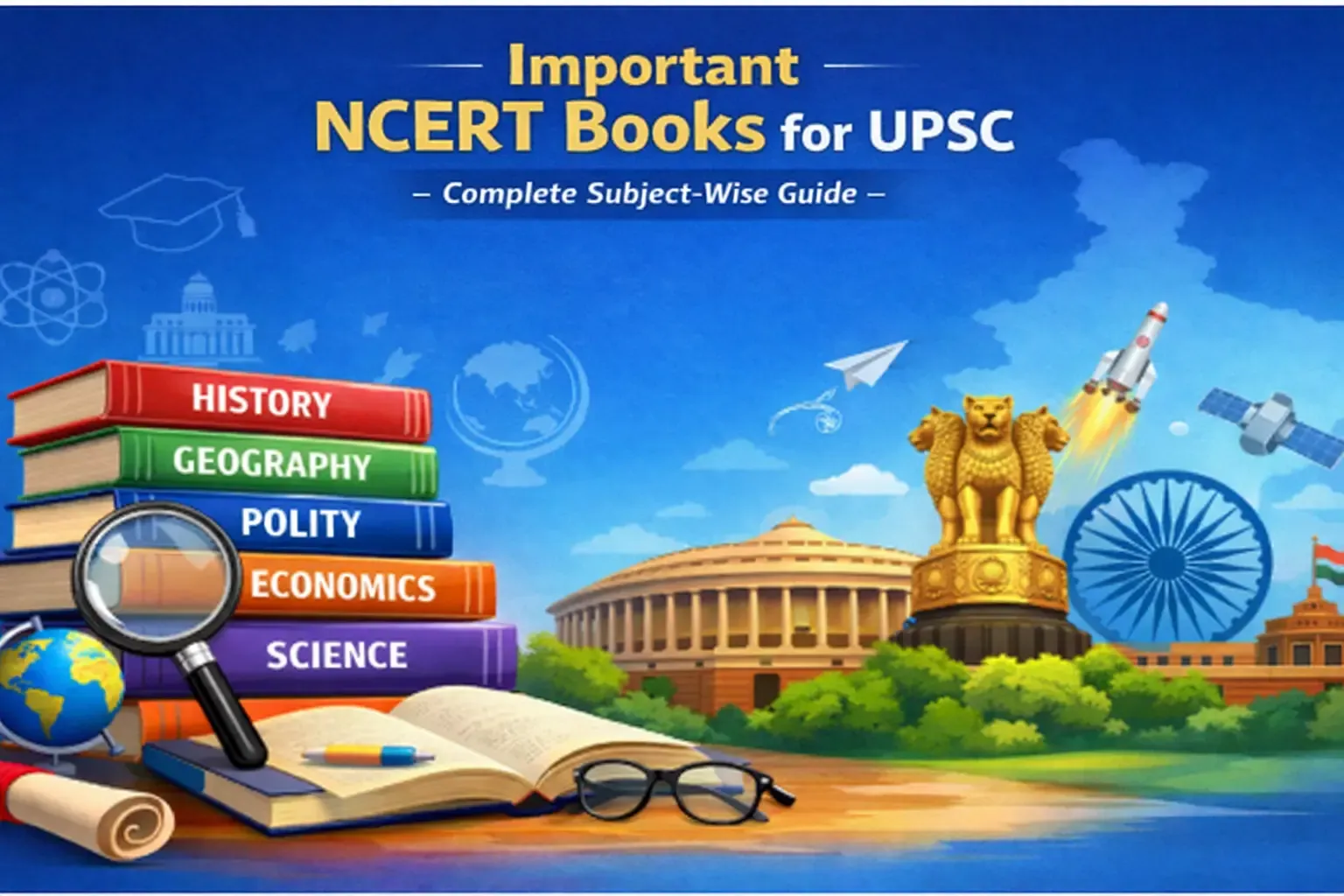
Important NCERT Books for UPSC Exams – Complete Subject-Wise Guide
When you begin to think about the way you will be handling your planning on how to take the UPSC Civil Services, the idea that comes to your mind is;
“Should I begin with NCERTs or jump directly to reference books?”
That’s why people always say the same thing: first start studying with NCERT books and don’t begin with difficult or advanced books.
We will inform you what to read in NCERT, what to read in NCERT, how to read in NCERT, how to establish a good foundation to the UPSC just as a good parent will get you through things bit by bit.
UPSC is not an ordinary exam.
It does not reward those who merely memorize facts, it rewards those who understand concepts deeply and think analytically.
It is precisely the reason why NCERT books have been the initial step in every IAS aspirant who is not taking his studies lightly.
Reading NCERT History you not only memorize dates but you also know why something happened. This clarity helps you:
Toppers often say:
“If you underestimated NCERT, you underestimated UPSC.”
Look at previous years’ Prelims papers — a significant number of questions are either directly or indirectly based on NCERT concepts.
In Mains, the depth and clarity required do not come from expensive coaching material, they come from strong fundamentals built through NCERTs.
At Vedanta IAS Academy, we have mentored many UPSC aspirants, and one thing we often notice is:
Students who took NCERT seriously built stronger foundations and performed better consistently.
Remember this —
NCERT is the ground on which your entire UPSC preparation stands. Strengthen the ground first.
Below is a carefully curated list aligned with the UPSC syllabus and consistently recommended by toppers.
📚 History
(Optional but recommended: Old NCERT by R.S. Sharma & Satish Chandra for deeper understanding.)
🌍 Geography
🏛 Polity
💰 Economics
🔬 Science & Environment
Buying NCERTs is not enough.
Reading them once casually is also not enough.
You must treat NCERT as an active learning process, not passive reading.
Expert NCERT Strategy
1. First Reading – Fast & Flow-Based
Read quickly to understand structure and themes. Don’t underline yet.
2. Second Reading – Active & Analytical
Underline important lines. Write short notes in margins in your own words.
3. Focus on Maps & Diagrams
Especially in History and Geography. Many Prelims questions come directly from maps.
4. Link with Current Affairs
Whenever you read about:
Go back and connect it with NCERT concepts.
5. Solve Chapter-End Questions
They develop analytical thinking required for UPSC Mains.
6. Revision is Non-Negotiable
Read NCERT at least three times:
Use spaced repetition for long-term retention.
❌ Reading only to “complete syllabus”
❌ Skipping Class 6–8 thinking they are too basic
❌ Jumping directly to advanced books
❌ Ignoring revision
If your basics are weak, start from Class 6. There is no shame in building fundamentals.
UPSC is not about speed — it is about clarity.
Once your NCERT foundation is strong, move to standard reference books:
Bipin Chandra - (This book is helpful for UPSC Mains because it explains the freedom struggle in detail. )
But remember these books make sense only if your basics are clear.
There are no shortcuts in UPSC.
UPSC preparation is a marathon, not a sprint. NCERTs are like your running shoes. Without them, you cannot move forward effectively. Many aspirants search for shortcuts. But trust this:
Time invested in NCERT is never wasted.
If you haven’t started yet for UPSC 2026 — start today.
Read just one chapter. Momentum builds gradually.
Your IAS journey begins with NCERT.
All the best, future civil servants 🇮🇳
Team Vedanta IAS Academy
Q1. Old NCERT or New NCERT — Which is Better?
Ans. Both are useful.
Old NCERTs are more detailed (especially History).
New NCERTs are concise and better aligned with the current pattern.
If time permits, read both. Otherwise, new NCERTs are sufficient.
Q2. How Much Time Does It Take to Complete NCERT?
Ans.If you study 3–4 hours daily with focus, you can complete relevant NCERTs in 3–4 months.
Do not rush. Focus on understanding.
Q3. Are NCERTs Only for Prelims?
Ans.No.
They are essential for Prelims, Mains, and Interview.
Conceptual clarity from NCERT improves answer quality in Mains.
Q4. PDF or Physical Book?
Ans.Physical books are better for highlighting and making notes.
However, PDFs from the official NCERT website are free and accessible.
Q5. How Can Vedanta IAS Academy Help?
Ans.At Vedanta IAS Academy, we provide:
Our approach:
Build clarity through NCERT → Connect with advanced sources → Practice answer writing.
No comments yet. Be the first to comment!