Same Sex Marriage in India is a major constitutional, legal, and social issue linked to LGBTQ+ rights, equality, and personal liberty. This article explains the legal status of same sex marriage in India, Supreme Court judgments, Section 377, constitutional debates, challenges faced by LGBTQ+ couples, and the future of marriage rights in India. A useful guide for UPSC aspirants, law students, and readers interested in Indian constitutional and social issues.
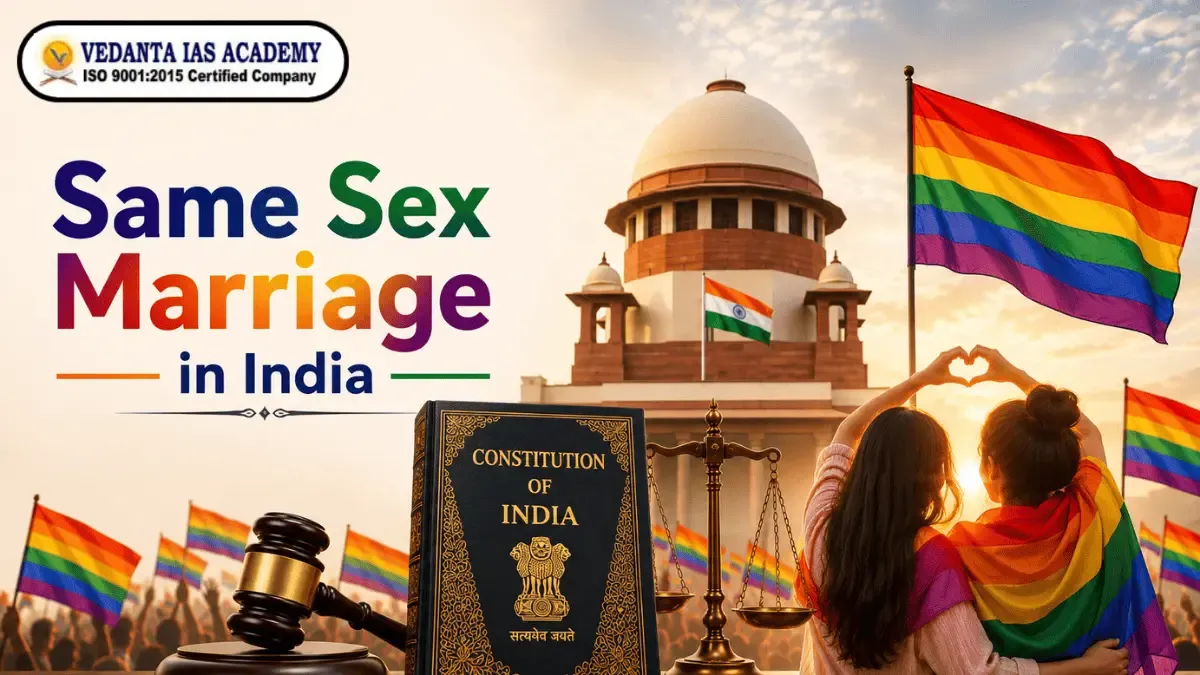

Same sex marriage: an officially recognised relationship between two men or two women. As with any other marriage it has legal rights including co habitation, rights to property, inheritance, adoption of children and all other benefits that the law gives to spouses. As of 2026, about 38 countries have laws that allow same-sex marriage. It is not recognized by any law in India however.
For marriage in India, personal laws are applicable, the Hindu Marriage Act, 1955, the Muslim Personal Law (Shariat) Application Act, 1937, the Indian Christian Marriage Act, 1872, the Special Marriage Act, 1954, and others. Currently, none of these laws contains or recognizes same sex marriages.
Here’s a short and clean version:
This is the most important and most frequently misreported section. Let us break it down accurately.
The Bench Composition
1. CJI D.Y. Chandrachud
Presided over the bench. Wrote a dissenting opinion favouring recognition of queer unions under the Special Marriage Act. DISSENT (Minority)
2. Justice S.K. Kaul
Penned a separate dissenting judgment. Supported recognising civil unions for same sex couples. DISSENT (Minority)
3. Justice S. Ravindra Bhat
Delivered the majority opinion (on behalf of himself and Justice Hima Kohli). Against recognising same sex marriage. MAJORITY
4. Justice Hima Kohli
Concurred with Justice Bhat's majority opinion against recognition. MAJORITY
5. Justice P.S. Narasimha
Wrote a separate concurring opinion agreeing with Justice Bhat. The right to marry is statutory, not constitutional. MAJORITY
As of 2026, same sex marriage is not legally recognised in India under any personal or civil law. The table below summarises the rights situation:
|
Right / Entitlement |
Status for Same Sex Couples |
|
Legal marriage recognition |
NOT AVAILABLE |
|
Joint adoption of children |
NOT AVAILABLE |
|
Inheritance rights through marriage |
NOT AVAILABLE |
|
Spouse insurance/pension benefits |
NOT AVAILABLE |
|
Next-of-kin status in medical emergencies |
NOT LEGALLY RECOGNISED |
|
Civil union or domestic partnership |
NO LAW EXISTS |
|
Right to live freely (post-2018) |
PROTECTED |
|
Right to dignity and equality (Articles 14, 21) |
PROTECTED |
|
Protection from criminal prosecution for relationship |
PROTECTED (post-2018) |
|
Right to choose partner |
PROTECTED |
|
Single-person adoption (individual, not couple) |
COMPLEX / CASE-SPECIFIC |
The debate on same sex marriage touches several fundamental constitutional provisions:
Key Constitutional Articles in the Debate
GS-II Relevance Constitution, Rights, Governance
1. Article 14 - Right to Equality before the law; denying marriage rights to same sex couples raises equality concerns
2. Article 15 - Prohibition of discrimination on grounds of sex; sexual orientation may be read into "sex"
3. Article 19(1)(a) - Freedom of expression, which includes right to identity
4. Article 21- Right to life and personal liberty, interpreted to include right to dignity, privacy (K.S. Puttaswamy, 2017), and autonomy
5. Article 25 - Freedom of religion; raised by opponents arguing marriage is a religious institution
6. Article 32 - Right to constitutional remedies; the petitions were filed directly in the Supreme Court under this Article
Legal Challenges
Because same sex marriage is not recognised, LGBTQ+ couples face a wide range of legal challenges in daily life:
1. Parliament to act
The Supreme Court was unequivocal – the ball now lies in Parliament’s court. Only elected legislators can amend the Special Marriage Act or pass a new law recognising same sex unions. As of 2026, no major political party in India has voiced support for same sex marriage. The ruling party has opposed it, the opposition has been largely silent.
2. High Level Committee on LGBTQIA+ Rights
The Supreme Court has directed the Union Government to constitute a high-level committee to examine the rights that can be conferred on same-sex couples, such as opening joint bank accounts, insurance nominations and hospital visitation rights, without calling it “marriage”. The status of the report of this committee is not yet publicly available as of May 2026.
3. The Public Opinion on the Move
Urban and younger Indians are far more receptive to LGBTQ+ rights than older and rural Indians. As this generation becomes politically active, parliamentary opinion may change. Pride parades in Delhi, Mumbai, Bengaluru, Chennai, Hyderabad and Kolkata now see thousands of participants every year.
4. Legal Route Available
The 2023 verdict was not definitive in the absolute sense. Petitioners may come back to the court with new arguments, or Parliament’s inaction can be challenged in the future. The dissenting opinions by CJI Chandrachud and Justice Kaul provide a strong constitutional basis for future petitions.
5. International Pressure and India's Global Image
With approximately 38 countries now having legalised same sex marriage and global human rights norms evolving, there is increasing international scrutiny on India's legal framework. India's aspiration to be a leading global democracy may increasingly require addressing this gap.
Same sex marriage in India remains an important legal, constitutional, and social issue. The debate involves equality, law, democratic values, and human dignity. While same sex marriage is not currently legal in India, discussions around rights, recognition, and legal reform continue. Understanding this topic helps readers better understand modern constitutional debates and the changing conversation around LGBTQ+ rights in India.
Q1. Is same sex marriage legal in India?
No. At present, same sex marriage is not legally recognized in India.
Q2. What did the Supreme Court say about same sex marriage in India?
The Supreme Court did not legalize same sex marriage and said major changes in marriage law should come mainly through Parliament.
Q3. Which constitutional articles are linked to same sex marriage?
The debate often involves Article 14 (Equality), Article 15 (Non-discrimination), and Article 21 (Right to Life and Personal Liberty).
Q4. Can same sex couples adopt children in India?
Adoption rights remain legally complex and depend on existing laws and regulations.
Q5. What is the future of same sex marriage in India?
The future debate may continue through legal discussion, legislative action, and changing social views.
No comments yet. Be the first to comment!