Lodhi Samaj Scholarship Test Result Out 2026
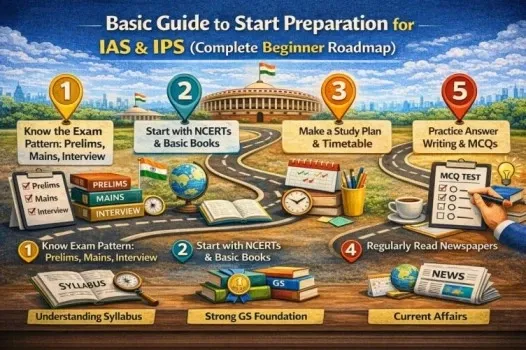
Preparing for IAS or IPS is a long journey, but the right start decides everything. Most beginners fail not because of lack of ability, but because of confusion, wrong guidance, and poor planning in the first year. This guide explains how a beginner should start IAS–IPS preparation step by step, without unnecessary pressure or misinformation.
Before starting preparation, you must clearly understand what IAS and IPS actually are.
What is IAS?
Indian Administrative Service (IAS) officers handle:
Policy implementation
District administration
Development programs
Revenue and law & order coordination
What is IPS?
Indian Police Service (IPS) officers focus on:
Internal security
Law & order
Crime control
Police administration at state and central levels
👉 Important point:
Both IAS and IPS come through the same UPSC Civil Services Examination. Rank decides service allocation, not a separate exam.
UPSC CSE has three stages:
GS Paper I – Merit based
CSAT (Paper II) – Qualifying (33%)
9 descriptive papers
Essay, GS I–IV, Optional, Language papers
275 marks
Tests clarity, attitude, leadership, awareness
👉 Beginners should never start reading without understanding this structure.
There is no fixed age, but ideal stages are:
School (Class 11–12): Awareness + reading habit
College (1st–2nd year): Foundation preparation
Final year / Graduates: Serious attempt planning
Working professionals: Smart + limited-time strategy
👉 Early start helps, but consistency matters more than age.
Download the official syllabus and:
Print it
Read it daily
Link every topic you study to syllabus
Most beginners ignore this and regret later.
NCERTs create conceptual clarity. Start with:
History (6–12)
Geography (6–12)
Polity (9–12)
Economics (9–12)
Environment (11–12)
👉 Do not rush. Understand concepts instead of memorising.
After NCERTs, move to standard books:
Polity – Laxmikant
History – Spectrum (Modern)
Geography – GC Leong
Economy – Basic reference + current affairs
Environment – Selective reading
⚠️ Common mistake: Buying 5–6 books for one subject.
Daily newspaper reading is non-negotiable.
Best options:
The Hindu
Indian Express
Focus on:
Government schemes
Supreme Court judgments
International relations
Economy & environment
👉 Don’t read like a newspaper reader. Read like a future administrator.
Optional subject plays a major role in rank.
Choose optional based on:
Interest
Background
Availability of guidance
Previous year trends
⚠️ Biggest beginner mistake: Choosing optional just because “others are scoring”.
Realistic study hours:
Beginners: 4–6 hours/day
Intermediate stage: 6–8 hours/day
Peak phase: 8–10 hours/day
👉 Studying 12–14 hours initially leads to burnout.
Coaching is not compulsory.
Coaching helps if:
You need structure
You lack guidance
You are a beginner
Self-study works if:
You are disciplined
You follow toppers’ strategy
You analyse PYQs seriously
👉 Many toppers cleared without coaching.
PYQs show:
UPSC mindset
Important areas
Depth of questions
Solve PYQs:
After finishing each subject
For Prelims and Mains both
👉 PYQs are more important than reading extra material.
Starting without syllabus clarity
Ignoring CSAT
Running after too many sources
Not revising
Avoiding answer writing
Comparing journey with others
IAS preparation is a marathon, not a race.
1–2 hours: Static subject
1 hour: Newspaper
1 hour: Revision
30 minutes: Notes making
Weekly: Answer writing / MCQs
Consistency beats motivation.
IAS–IPS preparation tests:
Patience
Discipline
Emotional strength
There will be failures, delays, and self-doubt. This is normal.
👉 Remember: UPSC selects mature minds, not fast readers.
Yes. UPSC rewards consistency and clarity, not brilliance.
Basic maths is required for CSAT only (qualifying).
General category – 6 attempts (within age limit).
No. UPSC allows Hindi and regional languages.
After basic syllabus completion, not immediately on day one.
No comments yet. Be the first to comment!