
General Studies Paper – II: Governance, Constitution, Polity, Social Justice and International Relations
Context
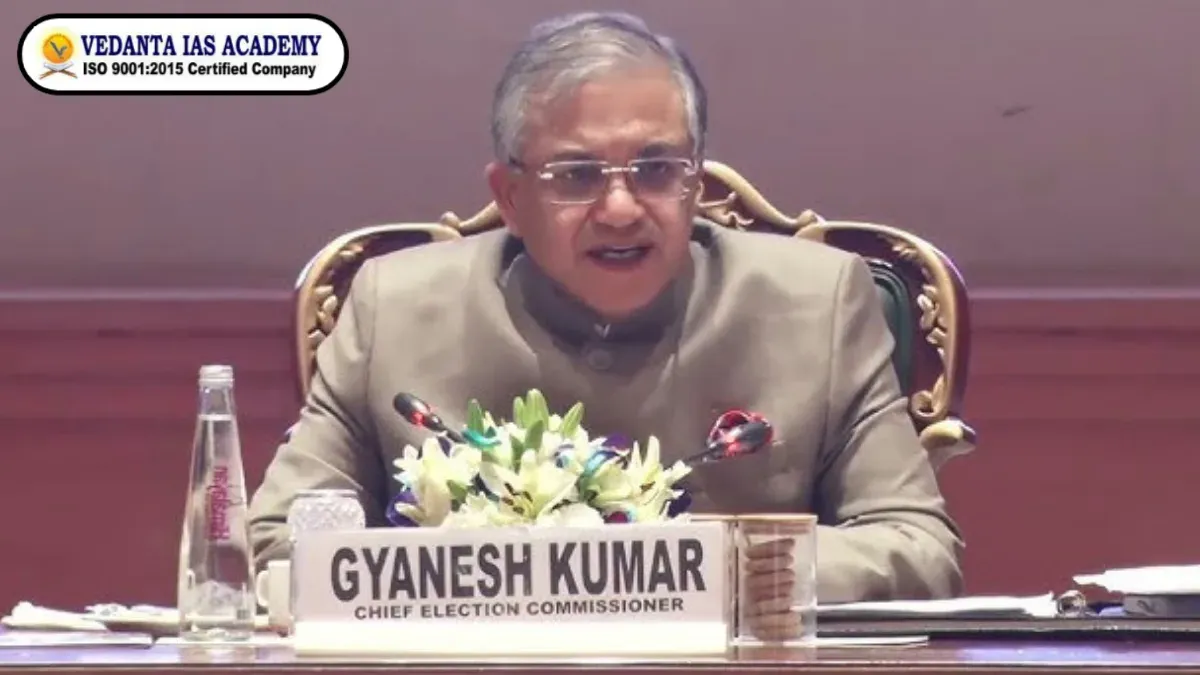
The role of the Election Commission of India (ECI) as a protector of Indian democracy has been unique. In 2001, former Prime Minister Atal Bihari Vajpayee honored it as an 'institution of the highest integrity'. In a democracy, a 'win-win' situation is one where all stakeholders trust the process, even if they have to make certain compromises. Currently, the impeachment motion against the Chief Election Commissioner (CEC) underscores this very crisis of trust.
A notice for the impeachment of the CEC has been submitted by 193 Opposition MPs. Although the passing of this motion is difficult due to the lack of numerical strength, its primary objective is to raise serious questions regarding institutional functioning rather than defeating an opponent.
⦁ Partisan Conduct: Inclination toward the ruling party and discriminatory decisions.
⦁ Discrepancies in Electoral Rolls: Depriving millions of eligible voters of their franchise through the 'Special Intensive Revision' (SIR).
⦁ Obstruction of Investigation: Obstructing impartial investigations into electoral fraud.
The Election Commission used Artificial Intelligence (AI) and the 'Logical Discrepancy' tool to "purify" the electoral rolls, which sparked several controversies:
⦁ The West Bengal Case: Here, 58.20 lakh names were removed during the draft stage, and 60.06 lakh names were kept 'under adjudication' in the final list.
⦁ Elections Amid Uncertainty: Elections were announced without determining the fate of nearly 10% of the voters.
⦁ Extraordinary Step: For the first time in history, the Supreme Court had to appoint over 500 judicial officers to settle the electoral roll issues.
The core mandate of the Election Commission under Article 324 is to ensure free and fair elections.
⦁ Constitutional Propriety: The involvement of another constitutional body (the Judiciary) by a constitutional institution for its routine tasks (preparing electoral rolls) raises questions about its functional efficiency.
⦁ Right to Vote: In a democracy, the exclusion of even a single eligible voter is considered an 'arbitrary exercise'.
⦁ Political Opposition: The 'Vote Adhikar Yatra' before the Bihar elections and protests in West Bengal took place.
⦁ Judicial Intervention: For the first time, a Chief Minister (Mamata Banerjee) had to personally present arguments in the Supreme Court against the Commission's unfair decisions.
⦁ Administrative Loss: The death of officials deployed on duty during the Special Revision (SIR) did not deter the Commission's rigid policy.
Despite the Leader of the Opposition (LOP) repeatedly holding press conferences to expose discrepancies in the electoral rolls, the poll body's stubbornness remained surprising.
⦁ Communication Gap: Communication channels between the Commission and Opposition parties were choked.
⦁ Persistence Despite Resistance: The CEC remained adamant on his policy despite the 'Vote Adhikar Yatra' before the Bihar elections and protests in West Bengal. Even the death of officials during the SIR process could not shake his resolve for "purification."
This struggle is not merely between political parties and the 'Referee' (CEC). It is a question concerning millions of voters struggling for their identity and rights. If at the end of the election process, the winner only celebrates their victory and the loser blames the system, the foundation of democracy weakens.
⦁ Strengthening the Appointment Process: Empowering a multilateral committee for the appointment of the Chief Election Commissioner (CEC) and Election Commissioners (ECs) that represents broad political and judicial consensus. This will provide institutional protection to the 'neutrality' of the institution.
⦁ Technical Transparency and Audit: Standards of 'Public Audit' and 'Explainable AI' should be adopted while using Artificial Intelligence (AI) and new algorithms in electoral processes, so that no doubt remains regarding the use of technology.
⦁ Institutional Dialogue Mechanism: There is a need for a formal and continuous dialogue platform between the Commission and all registered political parties. This will help clear misconceptions in time and maintain a bridge of trust between the 'Referee' and the 'Players'.
⦁ Constitutional Harmony: To reduce the need for intervention by other constitutional bodies (like the Judiciary) in basic tasks like electoral rolls, the Commission should make its internal grievance redressal systems more accessible and transparent.
The true success of democracy lies not merely in the seamless conduct of elections (Logistic Success), but in the 'procedural purity' and 'universal acceptance' of those elections. The Election Commission must perform its role as a 'Constitutional Guardian' in such a manner that its impartiality remains the bedrock of democratic discourse.
The current events are an opportunity for 'introspection' for a vital constitutional institution like the Election Commission. For the strength of democracy, it is essential that the Election Commission not only functions independently but its impartiality is also perceived as indisputable among all stakeholders. Using constitutional provisions like impeachment is a means to ensure institutional accountability, but the ultimate goal should be to restore the dignity and public trust of the institution.
Source - The Hindu
No comments yet. Be the first to comment!