
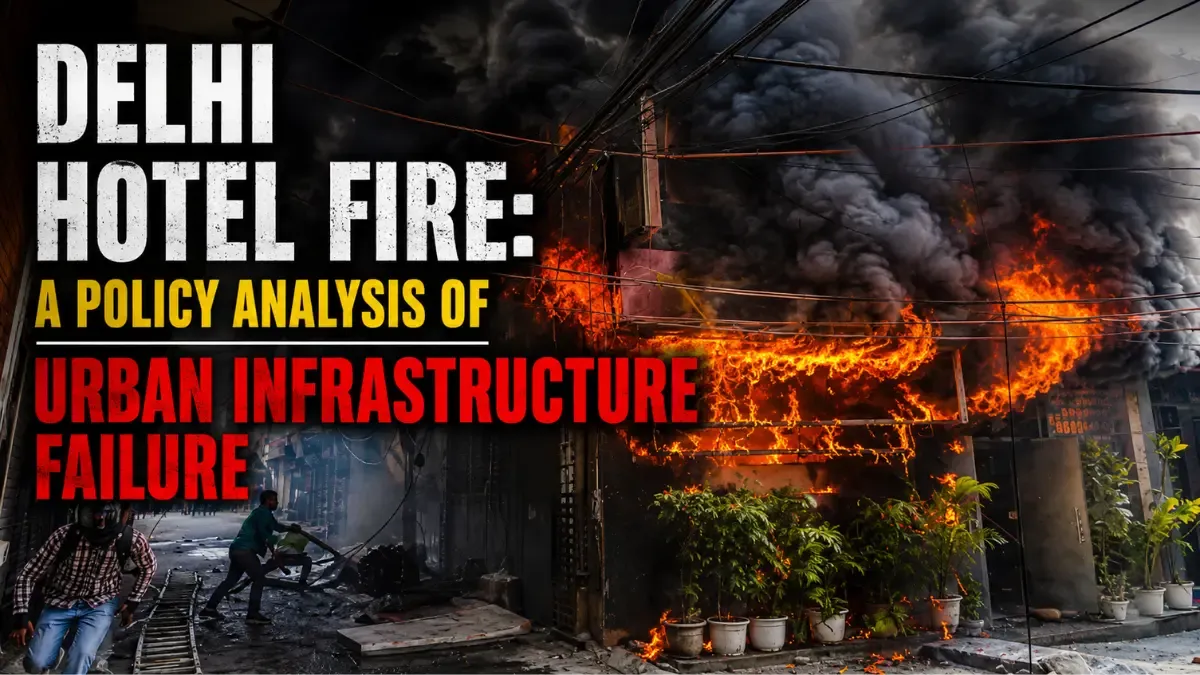
Rapid urbanization, unplanned construction, and the pursuit of commercial profits in Indian metropolises have created a severe crisis for urban safety. Due to the blatant disregard for safety standards in unregulated high-rise buildings, 'fire accidents' have now transformed into a commonplace administrative failure. At the foundational level, this problem is deeply linked to corruption and the lax enforcement of building bye-laws by local municipal bodies. The recent devastating fire at a six-storey hotel in Malviya Nagar (Hauz Rani), Delhi, which resulted in the tragic death of 21 people, including foreign nationals, is a direct and alarming consequence of this regulatory failure and illegally operated commercial activities.

General Studies Paper – III: Technology, Economic Development, Biodiversity, Environment, Security, and Disaster Management
⦁ Description of the Accident: A massive fire broke out at a six-storey hotel named 'Flourish Stay' located in Malviya Nagar, Delhi, engulfing three floors of the building.
⦁ Number of Casualties: 21 people lost their lives in this tragic accident (comprising 12 foreign nationals and 9 Indians), while 47 people were rescued and admitted to nearby hospitals for treatment.
⦁ Regulatory Violation: Investigations revealed that the building was approved by the municipal corporation for only 6 rooms, but it was illegally operating more than 20 rooms.
⦁ Safety Deficiencies: The building did not possess a 'No Objection Certificate' (Fire NOC) from the Delhi Fire Services. The entire structure had only a single shared entry-exit point and no emergency exit.
⦁ Administrative and Legal Action: The police arrested the building owner, Lovkesh Bajaj, and registered a case under the relevant sections of the Bharatiya Nyaya Sanhita (BNS). The Lieutenant-Governor ordered a magisterial inquiry into the incident, and the Prime Minister announced relief funds.
The core objective of the Bed-and-Breakfast (B&B) scheme is to promote tourism and provide guests with an authentic experience of Indian culture within residential accommodations. According to regulatory norms, this requires strict registration with the local tourism department and the municipal corporation, where fire safety stands as the most mandatory prerequisite.
In the case of 'Flourish Stay', the regulatory lapse manifested in the following ways:
⦁ Violation of Land Use: A commercial operation exceeding three times the approved capacity (20+ rooms instead of the sanctioned 6 rooms) was being conducted in a residential or limited commercial zone (Mixed Land-Use Violation).
⦁ Absence of Firefighting Infrastructure: As per the National Building Code (NBC), any commercial lodging must mandatorily feature sprinklers, fire alarms, hosepipes, and two-way exits, all of which were entirely absent here.
⦁ Failure of the Monitoring Mechanism: The lack of regular physical verification by the Tourism Department and the local body (MCD) reflects severe administrative inertia.
The annual report Accidental Deaths & Suicides in India (ADSI) published by the National Crime Records Bureau (NCRB) underscores the grim magnitude of fire tragedies in the country.
⦁ Annual Average Incidents: According to data from the NCRB and the National Disaster Management Authority (NDMA), approximately 160,000 fire incidents are recorded annually in India, claiming an average of over 27,000 lives.
⦁ Rise in Urban Commercial Hubs: Although nearly 55-57% of fire incidents occur in residential buildings, recent years have witnessed a sharp increase in mortality rates within illegally operated hotels, commercial complexes, coaching centers, and gaming zones (such as the Rajkot gaming zone tragedy in 2024 or the Goa nightclub accident in 2025).
⦁ Geographical Concentration: The highest number of fire accidents is recorded in states with high population density and rapid industrialization, such as Maharashtra, Gujarat, Delhi, and Madhya Pradesh, which together account for more than 50% of the total mortality.
⦁ Primary Cause: Approximately 70% of fire accidents are primarily caused by electrical short-circuits, resulting from overloading and substandard wiring.
The Delhi Police registered a case against the accused building owner under the Bharatiya Nyaya Sanhita (BNS), 2023.
⦁ This is equivalent to Sections 299 and 304 (Part II) of the erstwhile IPC.
⦁ Legal Application: It applies when a person performs an act or omission with the 'knowledge' that it is highly likely to cause death, even if there is no 'intention' to commit murder. Under this section, a person found guilty can face imprisonment up to 10 years or life imprisonment, along with a fine.
⦁ This is similar to Section 436 of the erstwhile IPC.
⦁ Legal Application: This section applies to an individual who uses fire or any explosive substance with the intent to destroy, or knowing it is likely to cause severe damage to, any building or human dwelling.
⦁ Relevance to this Case: The deliberate neglect of fire safety measures is legally recognized as an "act of positive omission", classifying it under criminal mischief and endangerment of public safety. It prescribes a punishment of imprisonment up to 10 years.
The Constitution of India contains explicit provisions regarding the protection of citizens' lives and the responsibilities of local bodies:
⦁ Article 21 (Protection of Life and Personal Liberty): The Supreme Court, through its various judgements, has clarified that the "right to a dignified life" encompasses the right to a safe environment and protection from disasters. The State cannot violate the fundamental rights of its citizens by permitting them to reside in environments plagued by fire hazards.
⦁ Directive Principles of State Policy (DPSP) – Articles 38 and 39: It is the duty of the State to secure a social order for the promotion of the welfare of the people and to safeguard the health and strength of workers and citizens.
⦁ Twelfth Schedule (Article 243W): Added via the 74th Constitutional Amendment Act, 1992, this schedule lists "Fire Services" and "Urban Planning" among the 18 mandatory functions of municipalities. Therefore, ensuring fire safety is a constitutional responsibility of local bodies.
The judiciary has consistently maintained a strict stance on fire safety in commercial and public buildings:
⦁ Uphaar Cinema Tragedy Case (Association of Victims of Uphaar Tragedy v.
Union of India, 2011): In this landmark case, the Supreme Court propounded the principle of 'Strict Liability'. The Court ruled that if safety standards are ignored in public spaces, both the building owner and the regulatory authorities will be jointly held liable for punitive and exemplary damages. The Court mandated clear evacuation maps, regular mock drills, and a complete ban on conditional or half-baked safety certificates for cinemas and high-rise structures.
⦁ Surat Coaching Center Fire (2019) and Gujarat High Court Directions: The court explicitly ruled that no commercial, educational, or residential-cum-commercial building can be permitted to operate without a valid fire NOC. Authorities retain the right to immediately seal such non-compliant buildings.
⦁ Self-Monitoring Guidelines for Industries and Buildings (2026): In recent legal interpretations, the Supreme Court ordered building owners, alongside local administrations, to ensure 'self-compliance' and publicly release biannual safety audit reports.
⦁ National Building Code (NBC), 2016: Its 'Part 4' is entirely dedicated to 'Fire and Life Safety'. It defines detailed technical standards for building classification, exit structures, and the utilization of fire-resistant construction materials.
⦁ National Scheme for Modernization of Fire Services: Under this framework, the Ministry of Home Affairs provides financial assistance to states to upgrade fire infrastructure, procure modern equipment, and train personnel.
⦁ Fire Safety Bill (Model Bill): The Central Government circulated a model bill for states to enact their independent 'Fire Prevention and Life Safety Measures Act', granting enhanced financial and punitive powers to the Directorate of Fire Services.
⦁ Urban Mitigation Plans (NDMA Guidelines): The National Disaster Management Authority recommends the deployment of 'Mini Fire Tenders' and the formation of Quick Response Teams (QRTs) specifically tailored for congested areas and narrow alleyways in cities.
The deaths of 12 foreign nationals in this incident have rendered the issue diplomatically and internationally sensitive:
⦁ Diplomatic Obligations (Vienna Convention, 1961 and 1963): Under the Vienna Convention on Consular Relations, if a foreign national dies in a host country, it is the legal obligation of the host nation (India) to immediately notify the respective foreign embassy, ensure the dignified preservation of the mortal remains, and facilitate their repatriation.
⦁ Medical Tourism Security: Due to its proximity to Max Hospital, the Hauz Rani area serves as a major hub for foreign patients visiting on 'medical visas'. Under the Government of India's 'Heal in India' initiative, providing secure logistics and safe accommodation, alongside medical treatment, is vital for the nation's global image and economic interests.
⦁ Rights of Foreign Nationals (Article 21): Article 21 of the Indian Constitution is not confined to Indian citizens alone; it guarantees the protection of life to every 'person' (including foreign nationals) present on Indian soil. Consequently, the State remains equally accountable for lapses in their safety.
The National Human Rights Commission (NHRC) and international human rights organizations (such as Amnesty International or the UN Human Rights Council) view these incidents through a broader lens:
⦁ Approach of the NHRC: The NHRC takes suo motu cognizance of such incidents. The Commission maintains that fires caused by administrative negligence are not mere accidents but constitute a "gross violation of human rights", as they strip citizens of their fundamental right to life. The Commission mandates states to provide immediate financial assistance to aggrieved families and enforcing personal accountability on erring officials.
⦁ International Human Rights Standards: Under Article 12 of the International Covenant on Economic, Social and Cultural Rights (ICESCR), everyone possesses the right to the enjoyment of the highest attainable standard of physical and mental health, which implicitly incorporates safe housing and workplaces. International bodies perceive these incidents as a stark 'lack of urban governance'.
Developed nations have minimized fire accidents through rigorous regulatory frameworks and advanced technology, offering valuable lessons for India:
⦁ United States of America (NFPA Codes): In the USA, the enforcement of standards established by the 'National Fire Protection Association' (NFPA) is exceptionally stringent. Every commercial building features an 'automatic sprinkler system' and 'smart smoke detectors' linked directly to local fire stations. Violations result in exorbitant fines and the permanent revocation of business licences.
⦁ United Kingdom (Regulatory Reform Order, 2005): The UK mandates a compulsory 'Fire Risk Assessment' for every building owner. Operating a building without conducting a certified third-party safety audit exposes the owner to severe criminal liability.
⦁ Disaster Management in Japan: In this high-risk nation, the utilization of fire-resistant materials in building construction is a statutory mandate, and every citizen is provided practical disaster management training at the community level.
This tragedy in Delhi is not merely an isolated accident; it stands as a vivid manifestation of the institutional hollowedness of regulatory bodies and administrative collusion. The incident illustrates how human lives are relegated to a secondary position in the pursuit of commercial gains, tarnishing India's global reputation as a 'safe tourism and medical destination'. Until 'zero tolerance' towards corruption is enforced and a stringent fear of the law is established, such structural failures will continue to consume innocent lives.
Based on research and policy deliberations, the following logical steps must be undertaken:
⦁ Regulatory Density and Technological Integration: All municipal corporations must integrate building fire safety certificates with geospatial mapping and 'drone surveillance' to instantly detect unauthorized constructions and operations exceeding sanctioned capacities.
⦁ Third-Party Audits and Accountability: Given the structural shortage of manpower within fire departments, statutory recognition should be granted to certified private security agencies to perform 'Third-Party Fire Safety Audits', as recommended by R&D wings and Administrative Reforms Commissions.
⦁ Single-Window Compliance and Stringent Penalties: A shared 'integrated portal' comprising tourism, municipal corporations, and the Fire Department should be developed for schemes like Bed-and-Breakfast. Authorities must be equipped with strict administrative powers to levy heavy financial penalties and execute immediate demolition or sealing of non-compliant structures.
⦁ Strengthening First Responders: Local residents played a swift role during the Hauz Rani incident. Therefore, under Civil Defence, local youth must be provided mandatory training in basic rescue operations and CPR.
The Malviya Nagar fire is a stark warning for India's urban planning and safety management paradigms. The objectives of economic prosperity and 'Ease of Doing Business' remain incomplete until we guarantee 'ease of living' and fundamental life safety to our citizens and guests. Only through the harmonization of policy reforms, the practical implementation of judicial guidelines, and absolute administrative accountability can we successfully prevent such man-made tragedies in the future.
Source - The Hindu
No comments yet. Be the first to comment!