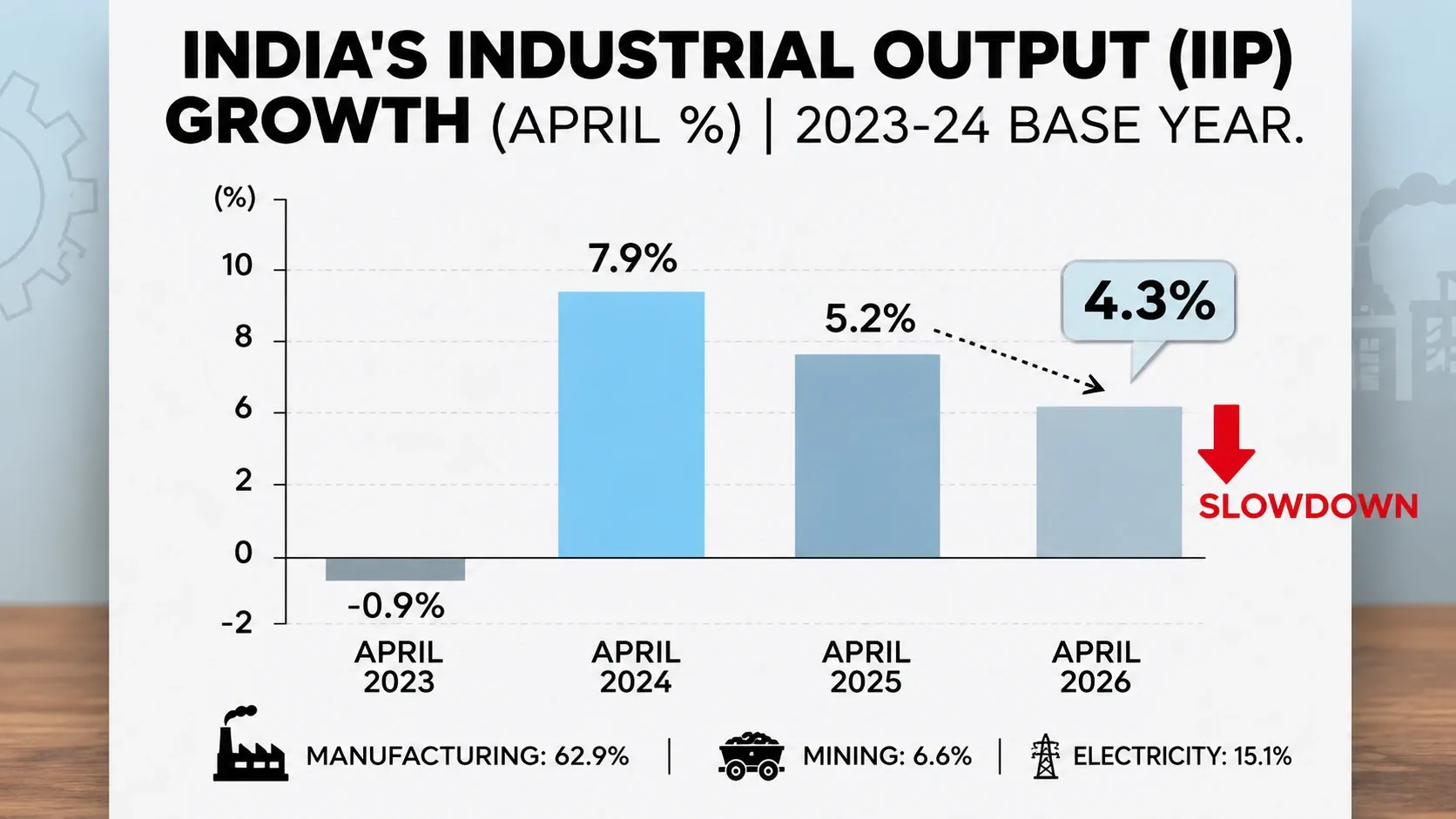

Periodic updating of the regulatory and statistical framework is essential to measure the industrial health of the Indian economy. The 'Index of Industrial Production' (IIP) is a core barometer assessing the country's manufacturing, mining, and electricity capabilities. At a foundational level, this index provides real-time economic data to policymakers and investors to evaluate the macroeconomic stability of the country.

General Studies Paper – III: Technology, Economic Development, Biodiversity, Environment, Security and Disaster Management.
Recently, the latest data of the Index of Industrial Production (IIP) released by the Ministry of Statistics and Programme Implementation (MoSPI) has attracted the attention of economic analysts. This data demonstrates the dual impact of global geopolitical tensions and India's internal structural policy reforms.
⦁ Publication of Data: The latest figures of the Index of Industrial Production (IIP) have been released recently by the Ministry of Statistics and Programme Implementation.
⦁ Significance of the Base Year: The significance of these figures for April 2026 is highly specific, as it is the first release under the new 2022-23 base series.
⦁ Geopolitical Context: This report reflects the industrial situation of the second full month following the U.S.-Israeli war on Iran.
⦁ Headline Growth Rate: In the month of April, India's industrial production registered a growth of 4.9% on a year-on-year basis.
⦁ Cautious Comparison: Due to extensive revisions made to the index's basket (basket of goods), weights, and methodology, it is advised to exercise caution when comparing this new data with older data.
The data released by the ministry indicates that despite massive disruptions in global crude oil and gas supply chains, India's industrial fundamentals have remained relatively resilient. However, a granular analysis makes it clear that this resilience is not entirely broad-based but is limited to specific sectors:
⦁ Capital Goods: A robust expansion of 16% year-on-year was recorded in the production of this sector. This growth is a direct result of infrastructure creation and the government continuously maintaining high public capital expenditure.
⦁ Consumer Durables: A growth of only 4.3% was observed in the production of this sector, which is relatively slow.
⦁ Consumer Non-Durables: A modest growth of just 2.8% was recorded in this sector.
⦁ Pressure on Household Consumption: These weak figures for consumer goods indicate that the rising costs of fuel and energy are exerting continuous pressure on household consumption capacity.
Far more significant than the headline growth rate number is the extensive change made to the structure of the IIP index itself at present. The primary objective of the revised series is to better reflect the actual structure of a rapidly changing Indian economy. Under this, the following structural changes have been made:
⦁ New Inclusion: New products and sectors have been incorporated into the index, and several old and obsolete items have been removed from the list.
⦁ Fourth Major Sector: A fourth major sector named 'Water supply, sewerage and waste management' has been included within the index with a weight of 2.02%.
⦁ Expansion of Electricity Category: The erstwhile electricity category has now been expanded to 'Electricity and Gas Supply.' Along with this, its weight has been increased to 10.87% from the earlier 7.99%.
⦁ Weight of Manufacturing: Manufacturing still remains the most dominant component of this index, although its total weight has declined marginally to 76.06% from 77.63%.
⦁ Mining and Quarrying: A major reduction has been recorded in the weight of this sector. Its weight has been reduced to 11.05% from 14.37%.
This report and its revised data are extremely important for economic policy-making due to the following reasons:
⦁ Realistic Economic Mapping: Compared to the old base year of 2011-12, the new base year of 2022-23 presents a realistic picture of the digital economy, renewable energy, and modern manufacturing.
⦁ Accurate GDP Calculation: The data of IIP serves as a primary input in refining the National Accounts Statistics and the quarterly and annual estimates of the Gross Domestic Product (GDP).
⦁ Investors' Confidence: This data helps shape long-term investment strategies by providing domestic and global investors (FDI/FPI) with transparent information on India's industrial health.
This new form and data of IIP will have a multi-dimensional impact on the Indian economy:
⦁ Positive Impact (Rise of Value Addition): The reduction in the weight of primary resource extraction (mining) and the increase in the weight of sectors like water and gas supply means that Indian industry is now moving strongly from 'primary production' towards 'value addition.' This will accelerate India's integration as a strong component hub in global supply chains.
⦁ Concerning Impact (Unbalanced Growth): While the massive 16% growth in infrastructure and capital goods is encouraging, the slow growth of 2.8% in consumer goods (especially non-durables) makes it clear that the purchasing power of the rural and urban middle class is still weak. If this disparity persists due to the energy crisis, long-term industrial growth could be hampered.
Based on research and policy discourse, the following logical steps need to be taken:
⦁ Rapid Implementation of 'Chain-linked Framework': As indicated by the government, a 'chain-linked framework' should be fully adopted to update sectoral weights more frequently and quickly. This will enable statistical data to keep pace with rapid structural changes in the economy.
⦁ Incentivizing Private Consumption: Instead of relying solely on public capital expenditure, the government should make policy efforts to revive household consumption. Controlling fuel and energy costs and providing tax relief can be helpful for this.
⦁ Continuous Inclusion of Green and Digital Sectors: As the economy is changing rapidly, the data collection mechanism should be further digitized so that data from newly emerging sectors (such as semiconductors and EV manufacturing) can also be immediately reflected in the IIP.
The revised IIP series is a progressive step toward the modernization of Indian economic statistics. Although this data substantiates the resilience of India's industrial fundamentals amidst geopolitical and energy supply disruptions, the unbalanced configuration within it demands policy reforms. Until household consumption is promoted alongside the development of basic infrastructure, India's dream of becoming a manufacturing hub cannot be fully realized. The successful implementation of the chain-linked framework will prove to be a milestone in providing a more accurate and timely measure of industrial health in the future.
Source: The Hindu
No comments yet. Be the first to comment!