

Context
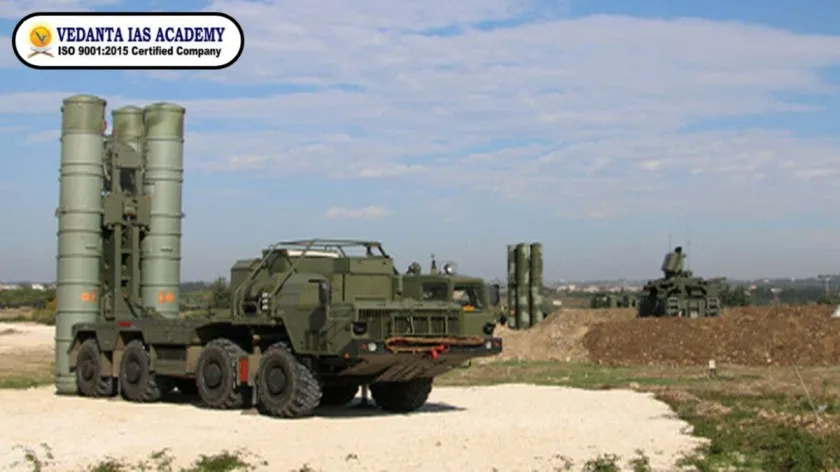
Recently, India has received the fourth squadron of the S-400 air defence system from Russia, which will be deployed in operational areas shortly. Following delays caused by the Russia-Ukraine conflict, this delivery has smoothed out according to the rescheduled timeline, which immensely strengthens India's long-range air defence network.
⦁ The S-400 'Triumf' is the world's most advanced, state-of-the-art, and mobile surface-to-air missile system (SAM) developed by Russia.
⦁ It is a multi-layered defence shield, capable of firing multiple categories of missiles simultaneously.
⦁ This system possesses the unerring capability to destroy enemy fighter jets, strategic bombers, drones, cruise missiles, and ballistic missiles right in the sky.
⦁ Delivery of the Fourth Squadron: According to defence sector sources, India has received the Russian-made fourth squadron of S-400 in May as per the scheduled timeline.
⦁ End of Conflict-Induced Delays: The technical disruptions and delays caused in this supply chain due to the Russia-Ukraine geopolitical crisis have been overcome.
⦁ Rescheduling of Supply: According to defence officials, the delivery of the remaining final (fifth) squadron under the original contract is highly likely to take place by the year 2027, and the supply mechanism is back on track.
⦁ Integration of AI (Artificial Intelligence): This is currently the biggest news that the S-400 is being equipped with 'Artificial Intelligence' (AI) enabled decision-support capabilities.
⦁ AI-Based Targeting: The new AI-tool will automatically identify aerial threats, arrange them in order of priority, and provide recommendations for action to the operator, although the final decision will rest solely with the human operator.
⦁ Unerring Firepower and Range: This system can engage enemy targets up to a distance of 400 kilometers and at an altitude of up to 30 kilometers.
⦁ Multi-Target Engagement: This system is capable of targeting 36 targets simultaneously and controlling 72 missiles at the same time.
⦁ Omnipresent Radar System: Its highly powerful radar can track more than 300 targets simultaneously within a radius of approximately 600 kilometers.
⦁ Four Missile Categories: This defence configuration utilizes a blend of four different categories of missiles (ultra-long range, long range, medium range, and short range).
⦁ Mobility: The entire system is mounted on trucks, which can be deployed or relocated from one place to another in just 5 to 10 minutes.
⦁ Anti-Stealth Capability: The S-400 is considered capable of detecting stealth aircraft and targets with low radar cross-sections, although its actual effectiveness in combat conditions depends on numerous factors.
⦁ Strategic Balance: Signed in the year 2018 between India and Russia, this $5.43-billion deal was made to counter the strategic challenge of a two-front war with China and Pakistan.
⦁ Aerospace and Aerial Sovereignty: Its primary objective was to enhance the 'Area Denial' (Anti-Access/Area Denial A2/AD) capability of the Indian Air Force (IAF) so that enemy aircraft do not dare to enter Indian airspace.
⦁ Protection of Vital Installations: To provide strategic security to critical national infrastructure such as the National Capital Region (NCR) and nuclear power plants.
⦁ Edge in Military Balance: The induction of the fourth squadron has given a massive boost to India's air defence capability on the northern and western borders.
⦁ Victory for Defence Diplomacy: Despite the pressure of American sanctions (CAATSA), India completed this deal, proving the mettle of its independent foreign policy and diplomatic sovereignty.
⦁ Technological Leap: The integration of AI (Artificial Intelligence) in the S-400 will minimize the combat response time of the Indian military, yielding a 'first-mover advantage' in a war scenario.
The S-400 system is not merely military hardware but a touchstone of India's strategic autonomy. The inclusion of AI proves that India is fully preparing itself for future network-centric warfare by linking traditional defence systems with cutting-edge algorithms.
⦁ Steps Towards Indigenization: Instead of permanent dependence on this foreign technology, India must accelerate the development of its indigenous 'Project Kusha' (LR-SAM).
⦁ AI Security and Cyber Security: Since AI is being integrated into the system, it will be imperative to secure its software against potential enemy cyberattacks and data manipulation.
⦁ Time-Bound Completion: The Ministry of Defence should use diplomatic channels to ensure the delivery of the fifth squadron by 2027 without any new bottlenecks.
The arrival of the fourth squadron of S-400 and the inclusion of artificial intelligence within it mark a revolutionary paradigm shift in India's air security matrix. Empowering the strategic vision of 'Atmanirbhar Bharat,' this technological leap sends a clear message that the nation is fully capable of taking decisions beyond geopolitical pressures to safeguard its geographical integrity.
Source: The Hindu
No comments yet. Be the first to comment!