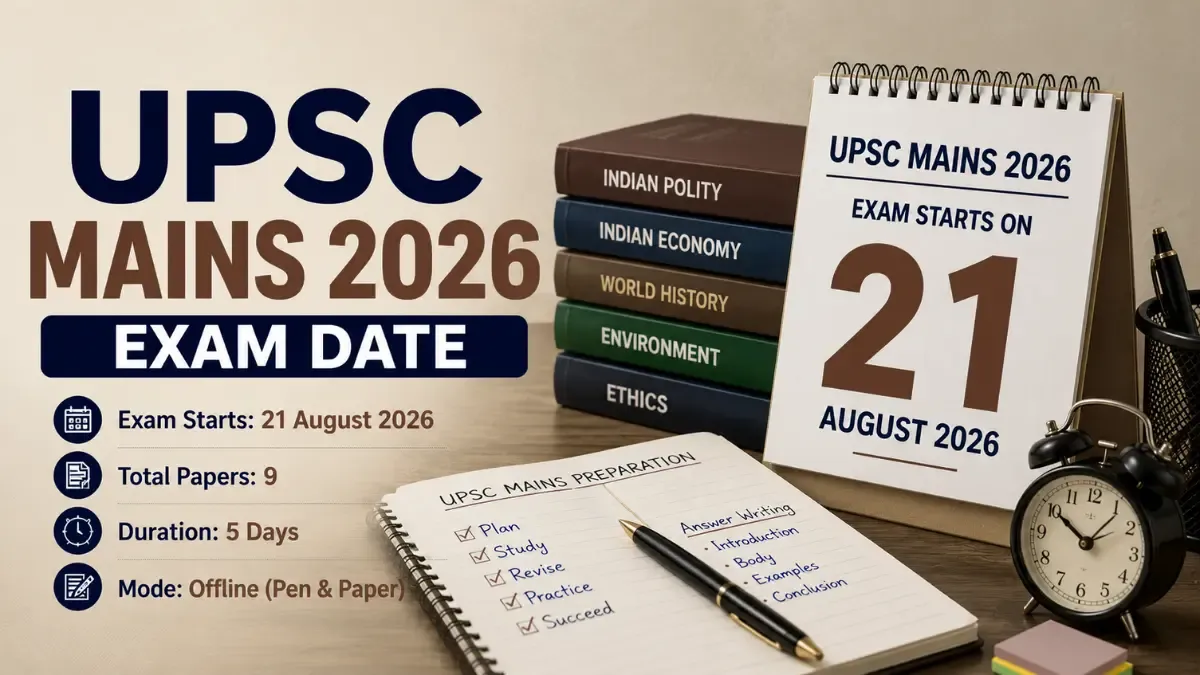
UPSC Mains 2026 Exam Date Out | Complete Time Table & Paper Schedule

UPSC Mains 2026 Exam Date: Schedule, Time Table, Paper Dates, Preparation Strategy
The official UPSC examination schedule, the UPSC Civil Services (Main) Examination 2026, will commence on 21st August 2026. The written exam will be for five days, and there will be nine descriptive papers. Only those candidates who qualify in the Preliminary Examination and are able to successfully submit the Detailed Application Form (DAF) will be eligible to appear for the Mains examination. Having the complete schedule, paper pattern, and marking scheme helps candidates prepare in a structured and confident manner.
UPSC Mains 2026 Important Dates
The Civil Services Main Examination 2026 will begin after the Preliminary Examination and the completion of the Detailed Application Form (DAF).
|
Event |
Status |
|
Preliminary Examination |
24 May 2026 |
|
Preliminary Result |
15 June 2026 |
|
Detailed Application Form (DAF) |
Available after the Prelims Result |
|
Admit Card |
Released before examination |
|
Main Examination 2026 |
August 21, 2026 - August 30, 2026 |
|
Personality Test |
After the Mains Result |
|
Final Result |
Declared after Interview |
UPSC Mains 2026 Official Examination Schedule
The UPSC Main Examination 2026 will start on 21 August 2026 and will be conducted over five examination days. The schedule is spread across two weekends to provide candidates with adequate time between major papers while maintaining a structured examination process.
The written examination consists of nine papers, each designed to assess different aspects of a candidate's knowledge and aptitude for public administration.
Official UPSC Mains 2026 Schedule
|
Date |
Forenoon Session 9:00 A.M. to 12:00 |
Afternoon Session 2:30 P.M. to 5:30 P.M. |
|
21 August 2026 (Friday) |
Essay |
No Paper |
|
22 August 2026 (Saturday) |
General Studies-I |
General Studies-II |
|
23.08.2026 (Sunday) |
General Studies-III |
General Studies-IV |
|
29.08.2026 (Saturday) |
Paper-A: Indian Language |
Paper-B English |
|
30.08.2026 (Sunday) |
Optional Subject-Paper-1 |
Optional Subject-Paper-2 |
The main examination is not simply to test factual knowledge. It tests the candidate’s ability to analyse issues, present arguments in a balanced way, communicate ideas clearly, and apply concepts to real-life governance and administrative situations.
The written examination includes nine descriptive papers. Out of these, seven papers are counted for final merit, while two language papers are qualifying in nature.
UPSC Mains 2026 Paper Structure
|
Paper |
Marks |
Nature |
|
Paper A – Indian Language |
300 |
Qualifying |
|
Paper B – English |
300 |
Qualifying |
|
Essay |
250 |
Merit |
|
General Studies Paper I |
250 |
Merit |
|
General Studies Paper II |
250 |
Merit |
|
General Studies Paper III |
250 |
Merit |
|
General Studies Paper IV |
250 |
Merit |
|
Optional Subject Paper I |
250 |
Merit |
|
Optional Subject Paper II |
250 |
Merit |
|
Total Written Marks (Merit) |
1750 |
Counted for Final Ranking |
Who Can Fill UPSC DAF 2026?
Only candidates who qualify in the Civil Services Preliminary Examination 2026 are eligible to fill out the Detailed Application Form (DAF). The DAF is a mandatory online application that must be completed within the deadline announced by the Union Public Service Commission (UPSC). Candidates who do not submit the DAF correctly cannot appear for the Main Examination, even if they have cleared the Preliminary stage.
You can also read: UPSC Mains 2026 Application Form: How to Fill Online Step-by-Step Guide
Information Required in UPSC DAF
Candidates are generally required to provide the following details while filling out the application:
- Personal information and contact details
- Educational qualifications
- Category and reservation details (if applicable)
- Choice of examination center
- Optional subject selection
- Language preferences
- Service preferences (IAS, IPS, IFS, and other services)
- Employment details, if applicable
- Uploading photograph, signature, and required certificates
Before submitting the form, candidates should carefully review every entry because the opportunity to make corrections may be limited.
UPSC Mains Preparation Strategy (30 Days)
A structured study plan helps candidates revise all important subjects without feeling overwhelmed. Instead of studying randomly, divide the remaining days into weekly goals.
Week-wise 30-Day Revision Plan
|
Week |
Focus Area |
|
Week 1 |
Revise the General Studies Paper I and II, practice answer writing |
|
Week 2 |
Revise General Studies Paper III and IV, solve previous year questions |
|
Week 3 |
Revise Optional Subject and Essay writing |
|
Week 4 |
Full-length mock tests, revision of current affairs and weak topics |
Daily Preparation Strategy
A balanced daily schedule is often more effective than studying continuously without planning.
A productive routine may include:
- Revise one major subject every day.
- Write at least two descriptive answers daily.
- Practice one essay every week.
- Revise important government schemes, reports, and current affairs.
- Review notes instead of reading new books.
- Analyse mistakes after every mock test.
- Sleep adequately to maintain concentration during the examination.
Improve Answer Writing
The Main Examination rewards quality rather than quantity. Good answers are usually clear, structured, and directly address the question.
Candidates should focus on:
- Writing a short introduction.
- Explaining the main points with headings.
- Using examples, constitutional provisions, committees, or reports where relevant.
- Drawing simple diagrams or flowcharts when they improve clarity.
- Writing a balanced conclusion instead of ending abruptly.
Regular answer writing improves speed, presentation, and confidence. Candidates preparing seriously should also practice using UPSC Previous Year Question Papers and refer to the UPSC Mains Syllabus 2026 while evaluating their performance.
What Mistakes Should Candidates Avoid Before the Main Examination?
Many candidates fail to meet their expectations, not due to a lack of knowledge, but because they make avoidable mistakes in the final weeks of preparation. Avoid these common mistakes to enhance your overall performance and reduce stress in exams.
1. Starting New Study Material
Many aspirants begin reading new books or coaching notes just before the examination. This often creates confusion and leaves less time for revision. It is better to revise trusted resources multiple times than to collect new material.
2. Ignoring Answer Writing Practice
The main examination is descriptive. Candidates who only read books without writing answers often struggle to complete papers within the allotted time. Daily answer writing improves speed, structure, and presentation.
3. Spending Too Much Time on Favourite Subjects
Some candidates repeatedly revise subjects they enjoy while ignoring weaker areas. Balanced preparation across General Studies, Essay and Optional papers is essential for achieving a good score.
4. Neglecting Revision
Revision helps retain important facts and concepts. Reading a topic once is usually not enough for a descriptive examination like UPSC Mains. Multiple revisions improve recall during the examination.
5. Poor Time Management
Many candidates fail to complete the entire question paper because they spend too much time on the first few questions. Practising timed mock tests helps develop better writing speed.
6. Ignoring Current Affairs
Current events remain important in General Studies, Essay and even Optional papers. Candidates should revise reliable current affairs notes instead of depending entirely on memory.
7. Not Analyzing Mock Tests
Mock tests are valuable only when candidates review their mistakes. Analysing weak areas helps improve content quality, presentation and time management before the actual examination.
8. Ignoring Physical and Mental Health
Studying continuously without proper sleep, hydration and short breaks can reduce concentration. Maintaining a healthy routine during the final month improves productivity and examination performance.
Final Advice for the Last Month
The final 30 days should be used to strengthen preparation rather than create unnecessary pressure. Candidates should trust their preparation, revise consistently, practise answer writing every day, and avoid comparing their progress with others.
A calm and disciplined approach is often more effective than studying for extremely long hours without a clear plan. Readers preparing for the written examination may also find UPSC Answer Writing Strategy, UPSC Interview Preparation, and UPSC Preparation Tips useful for building a complete preparation roadmap.
Frequently Asked Questions
Q1. What is UPSC Mains Exam Date for 2026?
Ans. UPSC Mains 2026 will begin on 21 August 2026, as per the official UPSC examination timetable. Only candidates who qualify for the Preliminary Examination and submit the DAF can appear for the Mains.
Q2. Is UPSC Mains timetable released?
Ans. Yes. UPSC has released the official Mains 2026 timetable with the complete paper-wise examination schedule and dates.
Q3. How many papers are there?
Ans. The UPSC Main Examination has nine descriptive papers. Seven papers are counted for merit, while two language papers are qualifying.
Q4. Is an essay compulsory?
Ans. Yes. The essay paper is compulsory for all candidates and carries 250 marks in the final merit calculation.
Q5. Is it optional compulsory?
Ans. Yes. Every candidate must choose one optional subject consisting of two papers, each carrying 250 marks.
Q6. How many days is UPSC Mains?
Ans. UPSC Mains 2026 will be conducted over five examination days across two weekends.
Q7. When will the admit card come?
Ans. The UPSC Mains Admit Card is usually released 2–3 weeks before the examination on the official UPSC website.
Q8. How many marks are needed?
Ans. There is no fixed qualifying score. The required marks vary every year based on vacancies, category, and overall candidate performance.
Q9. Is UPSC Mains offline?
Ans. Yes, UPSC main is conducted in offline mode, where candidates write descriptive answers using pen and paper.
0 Comments
No comments yet. Be the first to comment!
Reply to this Post
Newsletter
Letest Posts
UPSC Mains 2026 Exam Date Out | Complete Time Table & Paper Schedule
UPSC | 18 hours ago
UPSC Mains 2026 Exam Date, Syllabus, Time Table, Schedule
UPSC | 18 days ago
UPSC Mains 2026 Application Form: How to Fill Online Step-by-Step Guide
UPSC | 26 days ago
UPSC Mains Syllabus 2026: All 9 Papers Explained with Free PDF Download
UPSC | 26 days ago
UPSC Prelims 2026 Result Out: 13,343 Candidates Qualify for UPSC Mains
UPSC | 1 months ago
S-400 Air Defence System Explained: Impact on India’s Strategic Sovereignty
UPSC Current Affairs | 1 months ago
UPSC Prelims 2026 Result Out Soon: Expected Date & PDF Download
UPSC Current Affairs | 27 days ago
Index Rebasement and Index of Industrial Production (IIP): Key Points , Impact and Way Forward
UPSC Current Affairs | 2 months ago
Delhi Hotel Fire: Governance Challenges, Infrastructure Deficits and the Way Forward
UPSC Current Affairs | 2 months ago
Overcrowding of Prisons and Undertrials in India: Analysis of Governance, Jurisprudence and Ethics
UPSC Current Affairs | 2 months ago
Illicit Liquor Tragedy and Regulatory Failure: A Deepening Public Health Crisis
UPSC Current Affairs | 2 months ago
Slowdown in Index of Industrial Production (IIP): Technical Changes of New Series, Challenges and Way Forward
UPSC Current Affairs | 2 months ago
Adolescent Sexuality and Judicial Precedent
UPSC Current Affairs | 2 months ago
India-Canada Relations’ New Dawn: Strategic, Economic & Diaspora Partnership Resurgence
UPSC Current Affairs | 2 months ago