
06 Mar, 2026 11:36 AM

What is CSAT Exam in UPSC? Exam Pattern, Syllabus & Passing Marks Explained

If you are preparing for the UPSC Civil Services Exam, understanding CSAT is very important. At Vedanta IAS Academy, we guide aspirants to crack every stage of UPSC and CSAT is one of the first hurdles. Responds to all questions using a simple language on what is CSAT exam, its syllabus, exam pattern, passing marks and preparation strategy.

Why CSAT is Important in UPSC Prelims

UPSIC Prelims have two papers, namely GS Paper 1 and CSAT (Paper 2). CSAT, unlike GS Paper 1 marks, is qualitative in merit ranking. But do not underestimate it — failing CSAT means disqualification, no matter how good your GS score is.

  • The full form of CSAT  - Civil Services Aptitude Test
  • Introduced in UPSC Prelims from 2011
  • Qualifying paper — minimum 33% marks required
  • Tests analytical, logical, and reading comprehension skills
  • Negative marking applies — 1/3 marks deducted per wrong answer

UPSC CSAT Syllabus – Topic Wise Overview

The syllabus of the UPSC CSAT exams includes the following broad topics:

  • Comprehension Reading passages and response to questions.
  • Interpersonal Skills/ Communication.
  • Rational Thinking and Critical Analysis.
  • Decision-Making and Problem-Solving Skills
  • General Mental Ability and Analytical Thinking
  • Basic Numeracy -Numbers, percentages, ratio, data interpretation (Class 10 level)
  • English Language Comprehension (basic level)

Note: The math and reasoning questions are of Class 10 level — no advanced mathematics is required.

UPSC CSAT Exam Pattern Explained

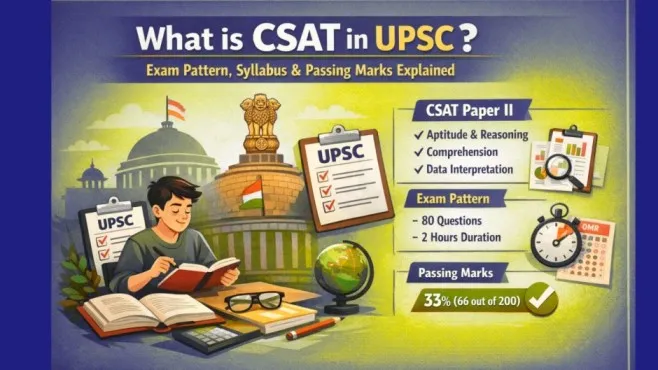
Quick overview of the CSAT question paper pattern:

  • Paper: (CSAT) UPSC Prelims Paper 2
  • Questions: MCQs (Multiple Choice Questions)
  • Total Questions: 80 Marks
  • Total Marks: 200 Marks
  • Time Duration: 2 hours (120 minutes)
  • Negative Marking: Yes — 0.833 marks deducted per wrong answer
  • Medium: Hindi and English 

Important Notes:

The 66.67 marks requirement applies to all categories.

  • Proper preparation is necessary as many candidates fail to clear the CSAT paper.
  • Incorrect answers result in a penalty of 
  • marks, while unanswered questions carry no penalty.

Strategy tip: Do not attempt questions you are unsure about — negative marking can cost you the paper.

Best Books for CSAT Preparation

Choosing the right books is key for a strong CSAT preparation strategy:

  • CSAT Manual by TMH (Tata McGraw Hill) — Most recommended book
  • Reasoning by M.K. Pandey — For logical reasoning
  • Verbal & Non-Verbal Reasoning by R.S. Aggarwal — Mental ability
  • NCERT Math Books (Class 6-10) — For basic numeracy
  • Previous Year UPSC CSAT Papers — Must practice for real exam feel
  • English newspapers daily — Improves reading comprehension speed

Simple Preparation Tips to Clear CSAT

It becomes easy to clear CSAT in the prelims of the UPSC with a proper study plan and regular practice. It is a qualifying paper, and therefore the candidates are expected to concentrate on the simple concepts and precision.

Preparation Tips:

Know the CSAT syllabus and emphasize key subjects such as understanding, reasoning and simple numeracy.

  • Read everyday to gain faster reading and comprehension.
  • Practice past year question papers to know the CSAT pattern of questions.
  • Basic maths e.g. number percentages, ratios and averages.
  • Practice practice tests so that they are able to become better at time management.
  • Guesswork is never desirable since negative marking can deduct the marks.
  • The most frequent errors in CSAT are made by students.

Lots of applicants do not pass CSAT as they disregard the paper or simply do not train enough. Easy mistakes to avoid can make the candidates pass the exam without challenges.

Common Mistakes Students Make in CSAT

Overlooking the preparation of CSAT and concentrating on GS Paper 1.

  • Failing to do enough practice before the exam.
  • Poor comprehension skills because of not being able to read.
  • Failing to spend time efficiently throughout the exam.
  • Misconception of fundamental maths subjects.
  • Failure to analyze mistakes of mock tests and strong areas.

By preventing such errors and practicing, the candidates of the CSAT paper in the UPSC Prelims can successfully pass the paper without much difficulty.

Final Tips to Qualify CSAT in UPSC Prelims

Follow these proven tips from Vedanta IAS Academy experts to clear CSAT easily:

  • Focus on reading comprehension first — it carries the highest weightage
  • Practice at least 10 previous year UPSC CSAT papers before the exam
  • Solve 2-3 mock tests every week to build speed and accuracy
  • Do not skip numeracy and data interpretation — easy marks available
  • Avoid blind guessing — negative marking can cost you the paper
  • Devote minimum 1 hour daily to CSAT during Prelims preparation
  • If weak in English, solve Hindi medium passages to save time
  • Target 25-27 correct answers to safely qualify (out of 80 questions)

Conclusion

CSAT is not difficult in case you strategize the correct strategy. It is highly achievable with practice, time management and proper guidance to qualify to be a CSAT. The awareness of the trend of the CSAT exam UPSC, and positive awareness of the syllabus and previous year papers will get you well ahead and ahead. The most effective method of being a part of the UPSC is by possessing the appropriate mentor and planning it.

Important FAQs about CSAT in UPSC

Q1. What is CSAT in UPSC?

Ans. CSAT is Paper 2 of the UPSC Prelims exam that tests aptitude, reasoning, and comprehension skills.

Q2. What are the CSAT passing marks for UPSC?

Ans. Candidates must score 33% (66 marks out of 200) to qualify the CSAT paper.

Q3. What topics are in the UPSC CSAT syllabus?

Ans. The UPSC CSAT syllabus includes comprehension, logical reasoning, basic numeracy, and decision making.

Q4. How many questions are in the CSAT paper?

Ans. The UPSC prelims CSAT paper has 80 objective questions.

Q5. Is CSAT qualifying or merit-based?

Ans. CSAT is a qualifying paper, yet the applicants have to acquire the qualifying marks in the UPSC CSAT to pass prelims.


0 Comments

No comments yet. Be the first to comment!

Reply to this Post