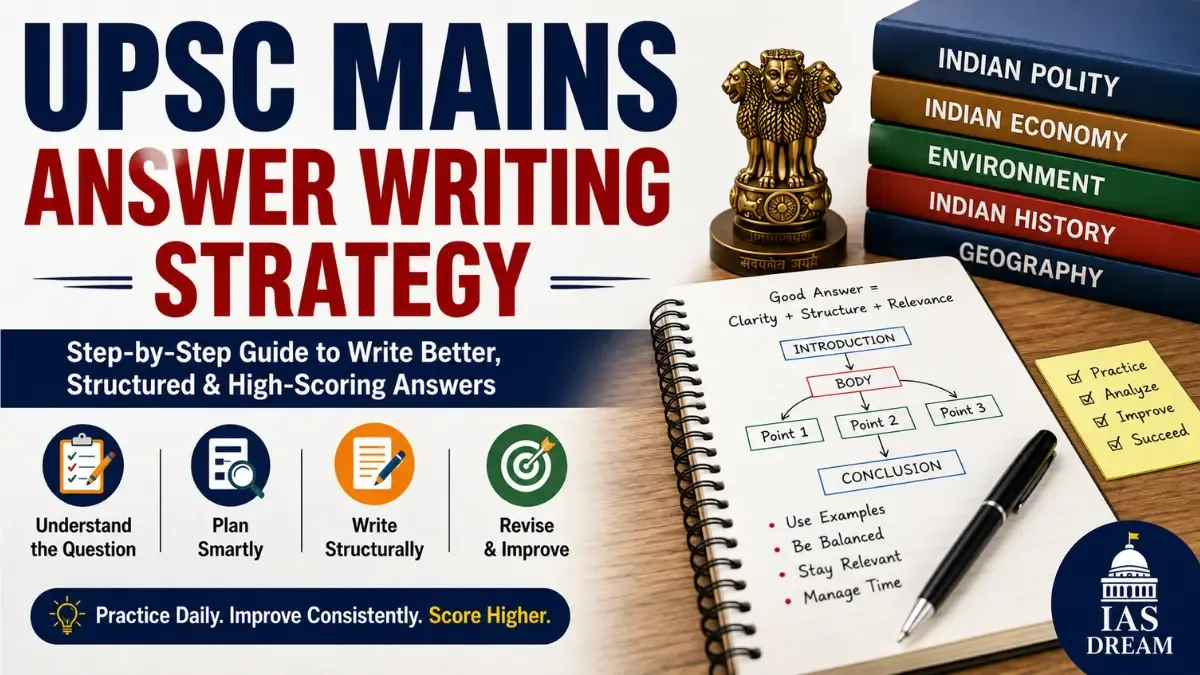
UPSC Mains Answer Writing Strategy: Step-by-Step Guide with Format & Daily Practice

UPSC Mains Answer Writing Strategy: Step-by-Step Guide with Format & Daily Practice
UPSC Mains answer writing is a skill of presenting clear, relevant, and well-structured answers within a limited time and word limit. The written exam has the merit of ranking before the interview, it plays a major role in improving the Mains scores. Regular practice enables the aspirants to develop analytical thinking, better presentation, and effective time management. it is very important for both the beginners and experienced candidates.
Quick Facts About UPSC Mains Answer Writing
|
Feature |
Details |
|
Exam Stage |
UPSC Civil Services (Mains) Examination |
|
Mode |
Descriptive (Written) |
|
Objective |
Evaluate analytical ability, conceptual understanding, and presentation skills. |
|
Key Skills |
Structure, clarity, relevance, critical thinking, and time management |
|
Best Practice |
Daily answer writing with regular self-evaluation |
|
Ideal Resources |
UPSC Previous Year Questions (PYQs), NCERTs, standard books, current affairs |
What Is UPSC Mains Answer Writing?
UPSC Mains answer writing is a process of writing structured, analytical, and relevant answers to descriptive questions asked in the Civil Services Main Examination. It tests not only your knowledge but also how well you can explain your knowledge in a fixed word limit and in a limited time.
The UPSC Mains examination requires the aspirant to develop arguments, explain concepts, analyze issues and provide balanced views unlike objective examinations where the candidate just needs to tick the right option. All answers must respond to the question’s demand and not just describe the topic.
A well-written answer generally includes three essential parts:
- A concise introduction that addresses the question.
- A logically organized body that explains the main points.
- A balanced conclusion that summarizes the discussion or suggests a constructive way forward.
Candidates preparing through UPSC Current Affairs, UPSC Mains Exam Pattern, and UPSC Preparation Strategy often improve their answer quality because these resources help them connect static concepts with contemporary issues.
Also Read: UPSC Mains Admit Card 2026
Why Is Answer Writing Important for UPSC Mains?
Answer writing is important because the UPSC Mains examination evaluates your ability to think critically, organize information, and express ideas clearly under examination conditions. Even candidates with excellent subject knowledge may score lower if they cannot present their answers effectively.
Regular answer writing practice helps aspirants:
- Improve analytical thinking.
- Learn to understand the exact demand of each question.
- Present information in a logical order.
- Manage time effectively during the examination.
- Write confidently within the prescribed word limit.
- Develop balanced opinions supported by facts and examples.
Aspirants should also complement answer writing with UPSC Mains Previous Year Questions, UPSC Notes, and UPSC Current Affairs to understand the changing nature of questions and improve content quality.
What Makes a High-Scoring UPSC Mains Answer?
A high-scoring UPSC Mains answer is one that directly answers the question, follows a logical structure, remains within the word limit, and presents relevant arguments supported by facts or examples where appropriate. Clarity and relevance matter more than writing lengthy answers.
Examiners assess whether a candidate has understood the question and addressed every part of it. A well-structured answer demonstrates analytical ability rather than simple memorization.
Characteristics of a High-Scoring Answer
|
Element |
Why It Matters |
|
Direct Answer |
Addresses the exact requirement of the question. |
|
Logical Structure |
Makes the answer easy to read and evaluate. |
|
Relevant Content |
Avoids unnecessary information and stays focused. |
|
Balanced Analysis |
Presents multiple perspectives where appropriate. |
|
Examples |
Improve clarity and strengthen arguments. |
|
Good Presentation |
Short paragraphs, headings, flowcharts, or diagrams enhance readability. |
|
Strong Conclusion |
Ends with a practical, balanced, or forward-looking statement. |
How to Build Consistency in Daily Practice?
Consistency develops answer-writing skills more effectively than occasional long study sessions. Even writing one quality answer every day creates steady improvement over time.
A simple daily routine could include:
- Read one editorial or current affairs article.
- Revise one static topic.
- Write one or two answers.
- Review your answers after a short break.
- Note one improvement for the next day.
Maintaining an answer-writing notebook also helps track progress and identify recurring mistakes.
Answer Writing Tips for UPSC Mains Exam 2026–27
Small improvements in presentation often lead to better scores. Effective answer writing is a combination of knowledge, clarity, and disciplined practice.
Practical Tips
- Read the question carefully before writing.
- Identify the directive word.
- Write a relevant introduction.
- Follow a logical structure.
- Keep paragraphs short.
- Use headings where appropriate.
- Support important points with examples.
- Mention constitutional provisions or committee recommendations only when relevant.
- Draw simple diagrams whenever they improve clarity.
- Stay within the prescribed word limit.
- Leave sufficient space between paragraphs.
- End with a balanced conclusion.
Avoid trying to impress the examiner with difficult vocabulary. Simple and precise language communicates ideas more effectively.
Common Mistakes to Avoid in UPSC Mains Answer Writing
Avoiding common mistakes is just as important as learning good writing techniques. Many candidates lose marks because of presentation errors rather than lack of knowledge.
Frequent Mistakes
❌ Misunderstanding the question.
❌ Ignoring the directive word.
❌ Writing unnecessary background information.
❌ Exceeding the word limit.
❌ Giving one-sided opinions.
❌ Writing long paragraphs without structure.
❌ Forgetting the conclusion.
❌ Using outdated facts.
❌ Spending too much time on one question.
❌ Poor handwriting and untidy presentation.
Reviewing your answers regularly helps identify these mistakes before the actual examination.
0 Comments
No comments yet. Be the first to comment!
Reply to this Post
Newsletter
Letest Posts
UPSC CSE 2027 Preparation Strategy: Complete Study Plan for Beginners
UPSC | 1 months ago

UPSC Mains Admit Card 2026: Direct Link & Download Guide
UPSC | 2 months ago
UPSC Mains 2026 Exam Date, Syllabus, Time Table, Schedule
UPSC | 3 months ago
UPSC Mains 2026 Application Form: How to Fill Online Step-by-Step Guide
UPSC | 3 months ago
UPSC Mains Syllabus 2026: All 9 Papers Explained with Free PDF Download
UPSC | 3 months ago
UPSC Prelims 2026 Result Out: 13,343 Candidates Qualify for UPSC Mains
UPSC | 3 months ago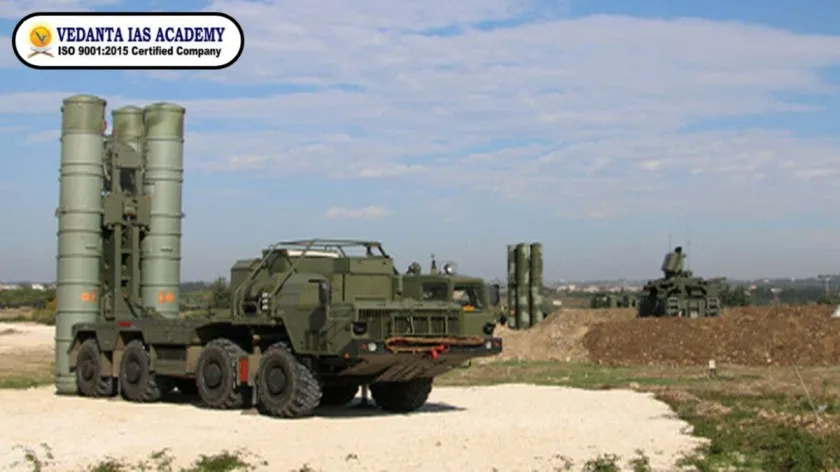
S-400 Air Defence System Explained: Impact on India’s Strategic Sovereignty
UPSC Current Affairs | 4 months ago
UPSC Prelims 2026 Result Out Soon: Expected Date & PDF Download
UPSC Current Affairs | 3 months ago
Index Rebasement and Index of Industrial Production (IIP): Key Points , Impact and Way Forward
UPSC Current Affairs | 4 months ago
Delhi Hotel Fire: Governance Challenges, Infrastructure Deficits and the Way Forward
UPSC Current Affairs | 4 months ago
Overcrowding of Prisons and Undertrials in India: Analysis of Governance, Jurisprudence and Ethics
UPSC Current Affairs | 4 months ago
Illicit Liquor Tragedy and Regulatory Failure: A Deepening Public Health Crisis
UPSC Current Affairs | 4 months ago
Slowdown in Index of Industrial Production (IIP): Technical Changes of New Series, Challenges and Way Forward
UPSC Current Affairs | 4 months ago